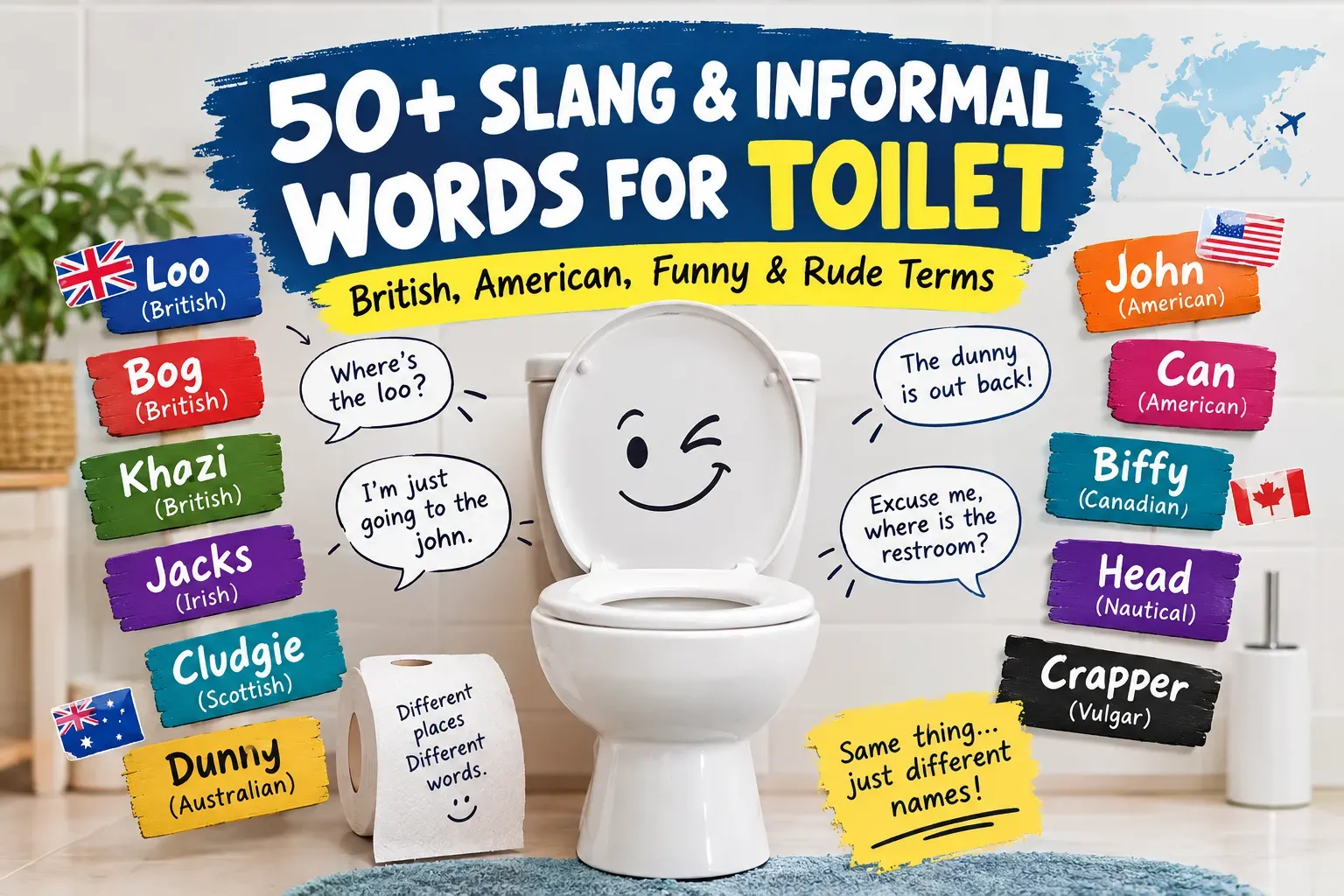
Looking for a slang word for toilet? English has plenty of alternatives, but they do not all mean exactly the same thing or sound appropriate in every situation.
A British speaker might say loo, an American might say john, an Australian might say dunny, while a sailor may call a ship’s toilet the head. Some terms are casual and harmless, while others are humorous, regional, old-fashioned, or downright vulgar.
This guide covers 50+ slang, informal, humorous, regional, historical, and euphemistic terms for toilet, along with their meanings, typical usage, and examples.
Quick Answer: What Are Some Slang Words for Toilet?
Common slang and informal words for toilet include:
loo, bog, khazi, lav, lavvy, jacks, cludgie, netty, john, can, biffy, crapper, dunny, head, throne, potty, thunderbox, privy, and jakes.
The right choice depends on where you are and how formal the situation is.
For a neutral or polite alternative, use toilet, bathroom, restroom, washroom, lavatory, or facilities.
Slang and Informal Toilet Words at a Glance
| Word | Region / Context | Tone |
|---|---|---|
| Loo | British / Irish | Informal, polite |
| Bog | British | Slang, rough |
| Khazi | British | Slang, dated |
| Lav / Lavvy | British | Informal |
| Jacks | Irish | Informal |
| Cludgie | Scottish | Slang |
| Netty | Northern England / Scotland | Dialect |
| John | US / Canada | Informal |
| Can | US / Canada | Informal |
| Biffy | US / Canada | Informal |
| Crapper | General | Vulgar |
| Dunny | Australia / New Zealand | Informal |
| Head | Nautical | Informal / occupational |
| Throne | General | Humorous |
| Latrine | Military / field settings | Contextual |
| Privy | Historical / outdoor toilet | Old-fashioned |
The important point is that these words are not interchangeable in every situation. A word that sounds normal in one country may sound strange or rude somewhere else.
British Slang for Toilet
British English has some of the most recognizable informal words for a toilet.
1. Loo
Loo is one of the most common informal British words for toilet. It is casual but not normally considered rude.
Example:
“Excuse me, where’s the loo?”
2. Bog
Bog is British slang for a toilet. It is much rougher and more casual than loo.
Example:
“He’s gone to the bog.”
Because of its tone, it is better suited to casual conversation than formal situations.
3. Khazi
Khazi is an informal British slang term for a toilet. It can sound dated or humorous depending on the speaker.
Example:
“The pub’s khazi is upstairs.”
4. Lav
Lav is a shortened form of lavatory. It is informal but generally less crude than words such as bog or crapper.
Example:
“I’ll be back in a minute. I’m just using the lav.”
5. Lavvy
Lavvy is another informal British form related to lavatory.
Example:
“The lavvy is at the end of the hallway.”
6. Jacks
Jacks is particularly associated with Ireland and is also heard in some British contexts.
Example:
“Where are the jacks?”
7. Thunderbox
Thunderbox is an old informal term for a toilet, particularly a portable or basic one.
It is now more likely to sound humorous or old-fashioned than everyday slang.
8. The Smallest Room
The smallest room is a humorous euphemism for the toilet.
Example:
“I’ll just visit the smallest room before we leave.”
It is playful rather than genuinely vulgar.
Irish and Scottish Toilet Slang
Regional English has its own vocabulary for toilets, and some terms are strongly associated with particular parts of the British Isles.
9. Jacks
Jacks is a familiar Irish term for a toilet.
Example:
“Do you know where the jacks are?”
10. Cludgie
Cludgie is Scottish slang for a toilet.
Example:
“The cludgie is just down the corridor.”
11. Netty
Netty is a regional term associated particularly with northern England and Scotland.
It is not something you would expect every English speaker to use.
12. Shankie
Shankie is another regional term associated with Scottish usage.
Because regional slang can vary considerably, it may not be familiar outside the area where it is used.
American and Canadian Words for Toilet
American and Canadian English use several informal terms that may sound unfamiliar to British speakers.
13. John
John is a familiar informal American word for a toilet.
Example:
“The john is down the hall.”
It is casual rather than highly offensive.
14. Can
Can is an informal American term for a toilet.
Example:
“Where’s the can?”
It can also have other meanings in English, so context matters.
15. Biffy
Biffy is an informal term used in some North American contexts for a toilet, particularly a portable toilet.
Example:
“There were several biffies near the campsite.”
16. Crapper
Crapper is a vulgar or crude word for a toilet.
It is more appropriate in jokes or very casual conversation than in professional settings.
The word is sometimes associated with Thomas Crapper, a British sanitary entrepreneur. However, the popular claim that he invented the flush toilet or created the word crapper is misleading.
17. Potty
Potty is most commonly associated with children or child-directed speech.
Example:
“The toddler needs to use the potty.”
It is not normally used as an adult slang term in formal conversation.
18. Outhouse
An outhouse is an outdoor toilet, especially one located away from a main building.
It describes a type of toilet rather than simply being a slang synonym for every toilet.
Example:
“The old cabin still has an outhouse behind it.”
19. Porta-Potty
Porta-Potty refers to a portable toilet, particularly the temporary units used at outdoor events and construction sites.
It is therefore better classified as a type of toilet, not simply slang.
Australian and New Zealand Toilet Slang
Australian and New Zealand English have several distinctive informal terms.
20. Dunny
Dunny is a well-known Australian informal word for a toilet, especially an outdoor toilet.
Example:
“The old dunny is behind the house.”
21. Long Drop
A long drop refers to a type of pit toilet commonly found in some rural, camping, and outdoor settings.
Example:
“There was a long drop at the campsite.”
This describes a particular toilet setup rather than being a general slang replacement for toilet.
Nautical and Military Terms
Some toilet words are strongly connected with particular occupations or environments.
22. Head
Head is the traditional nautical term for a toilet on a ship or boat.
Example:
“The crew member went below to use the head.”
It is still commonly understood in nautical contexts.
23. Latrine
A latrine is a toilet facility, especially in military, field, or outdoor settings.
Example:
“The soldiers were shown where the field latrine was.”
It is a contextual term rather than everyday slang.
24. KYBO
KYBO is an informal term used for certain outdoor toilet facilities, especially in camping and outdoor settings.
Because it is specialized, most everyday speakers would not use it as a normal synonym for toilet.
Funny and Humorous Names for a Toilet
Sometimes people use playful expressions instead of directly saying toilet.
25. The Throne
The throne humorously compares sitting on the toilet with sitting on a royal throne.
Example:
“He’s been sitting on the throne for twenty minutes.”
26. The Porcelain Throne
The porcelain throne is a longer and more humorous version of throne.
Example:
“I need five minutes on the porcelain throne.”
27. Porcelain God
Porcelain god is a humorous expression often connected with being sick over a toilet.
Example:
“After the party, he was praying to the porcelain god.”
28. Porcelain Goddess
Porcelain goddess is a variation of porcelain god, generally used humorously.
29. The Little Boys’ Room
The little boys’ room is a euphemistic expression for a men’s or boys’ toilet.
Example:
“I’ll be right back. I’m going to the little boys’ room.”
30. The Little Girls’ Room
The little girls’ room is the corresponding humorous expression for a women’s or girls’ toilet.
These expressions are playful rather than literal descriptions.
Rude and Vulgar Slang for Toilet
Some toilet slang is deliberately crude. These words can be useful when understanding jokes, movies, dialogue, or informal speech, but they are usually inappropriate in professional settings.
31. Crapper
Crapper is a vulgar informal word for a toilet.
Example:
“The old crapper is broken again.”
Although it is popularly connected with Thomas Crapper, the word crap existed before him.
32. Pisser
Pisser is a crude term connected with urination and can refer to a toilet in very informal speech.
Example:
“The pisser is around the corner.”
It is strongly inappropriate for polite or professional conversation.
33. Shithouse
Shithouse is extremely vulgar slang for a toilet or toilet building.
Example:
“The campsite’s shithouse was falling apart.”
This word should generally be avoided outside deliberately crude or comedic language.
Old-Fashioned and Historical Toilet Terms
English has used many colorful terms for toilets throughout history.
34. Privy
A privy traditionally means a private toilet, often an outdoor toilet without modern plumbing.
Example:
“The farmhouse once had a privy behind the kitchen.”
35. Jakes
Jakes is an old English term for a privy or toilet.
It survives historically and in some regional forms.
36. Necessary House
Necessary house was an old euphemistic term for a privy.
It is now mainly encountered in historical writing.
37. House of Office
House of office is another historical term for a toilet or privy building.
It is not modern everyday English.
38. Bog House
Bog house is an old term connected with a privy or toilet.
39. Bog Shop
Bog shop is another historical or old slang expression for a toilet.
40. Garderobe
A garderobe was a medieval toilet arrangement, particularly associated with castles and other buildings.
The term is mainly historical today.
41. Water Closet
Water closet, often abbreviated W.C., is an older formal term for a toilet.
It still appears in some signs and older buildings, but it is less common in everyday modern conversation.
Polite and Neutral Alternatives to “Toilet”
Not every alternative to toilet is slang. Some are ordinary, formal, regional, or euphemistic terms.
42. Toilet
Toilet is the standard everyday term in British English and is also widely understood internationally.
43. Bathroom
Bathroom is very common in American English.
In British English, bathroom can specifically suggest a room containing a bath, although people also use it informally when referring to a toilet.
44. Restroom
Restroom is a common American euphemism for a public toilet.
Example:
“Excuse me, where is the restroom?”
45. Washroom
Washroom is particularly common in Canadian English.
Example:
“The washroom is near the entrance.”
46. Lavatory
Lavatory is a formal or traditional word for a toilet.
It can sound more formal than toilet in ordinary conversation.
47. Powder Room
Powder room is a polite euphemism, particularly in American English, for a small guest toilet.
Example:
“The powder room is next to the dining room.”
48. Facilities
Facilities is a vague and polite way of referring to a toilet or toilet facilities.
Example:
“Could I use your facilities?”
49. Comfort Room
Comfort room, often shortened to CR, is a common expression in the Philippines for a public or private toilet.
50. Commode
Commode can refer to a toilet, although it is not normally considered slang.
It can also refer to a portable toilet chair, so the exact meaning depends on context.
Phrases for Going to the Toilet
English speakers also use indirect phrases when they do not want to say toilet directly.
51. Spend a Penny
Spend a penny is an old British euphemism for going to the toilet.
It comes from the historical practice of paying a small fee to use a public toilet.
52. Answer Nature’s Call
Answer nature’s call is a polite euphemism for going to the toilet.
Example:
“I’ll be back after I answer nature’s call.”
53. Powder My Nose
Powder my nose is a playful euphemism, traditionally associated with going to the ladies’ room.
54. Freshen Up
Freshen up can indirectly mean using the bathroom or toilet, especially when washing or making oneself presentable.
Example:
“I’m just going to freshen up before dinner.”
55. See a Man About a Dog
See a man about a dog is an old humorous expression sometimes used as a vague excuse for leaving, including going to the toilet.
56. Take a Leak
Take a leak is informal slang for urinating.
Example:
“I’ll be back. I need to take a leak.”
It is casual and should be avoided in formal situations.
57. Take a Piss
Take a piss is much cruder than take a leak.
It is common in vulgar informal speech but inappropriate in professional or polite settings.
58. Number One
Number one is a child-friendly or euphemistic way of referring to urination.
Example:
“Do you need to go number one?”
59. Number Two
Number two is a euphemistic expression for having a bowel movement.
Example:
“The child said he needed to do number two.”
Slang for Toilet Paper
Some slang expressions refer not to the toilet itself but to toilet paper.
60. Bum Fodder
Bum fodder is humorous British slang for toilet paper.
It is crude and playful rather than suitable for formal conversation.
61. Curl Paper
Curl paper is an older slang expression for toilet paper.
It is now uncommon and mainly useful when reading older or historical material.
Toilet Slang by Region
| Region / Context | Common Terms |
|---|---|
| UK | loo, bog, khazi, lav, lavvy |
| Ireland | jacks, loo |
| Scotland | cludgie, netty |
| US | john, can, restroom |
| Canada | washroom, john, biffy |
| Australia | dunny, long drop |
| New Zealand | dunny, long drop |
| Philippines | comfort room / CR |
| Nautical | head |
| Military / field | latrine |
Regional slang can vary even within the same country, so these labels should be treated as general usage guides rather than strict rules.
Slang vs. Polite Toilet Words: What Should You Use?
Choosing the right word depends on who you are talking to.
| Situation | Better Choice |
|---|---|
| Formal writing | toilet, lavatory |
| British everyday conversation | loo |
| Casual British slang | bog, khazi |
| Irish informal speech | jacks |
| Scottish regional speech | cludgie |
| American everyday speech | bathroom, restroom |
| Canadian usage | washroom |
| Australian informal speech | dunny |
| Nautical setting | head |
| Military / field setting | latrine |
| Humorous conversation | throne, porcelain throne |
| Very crude speech | crapper, pisser |
| Talking to children | potty, number one, number two |
The safest rule is simple: use slang when the situation is casual and you know the audience.
Words That Can Confuse Travelers
Toilet vocabulary changes significantly between English-speaking countries.
Bathroom
An American may say bathroom when they simply mean a toilet. A British speaker may understand it more literally as a room containing a bath.
Restroom
Restroom is strongly associated with American English, especially for public facilities.
Washroom
Washroom is especially common in Canada.
John
An American speaker may use john casually for a toilet, but someone unfamiliar with American slang may not immediately understand it.
Knowing these differences can make travel and everyday conversation easier.
Are All These Words Really Synonyms for Toilet?
No.
This is an important distinction.
Some terms above are direct informal names for a toilet, such as loo, bog, john, and dunny. Others describe a type of toilet, such as outhouse, porta-potty, and long drop. Some are humorous expressions, such as throne, while others are euphemisms or ordinary alternatives, such as bathroom, restroom, and washroom.
So, although they can all appear in searches for “slang words for toilet,” they should not be treated as exact synonyms.
FAQs About Toilet Slang
What is the most common slang word for toilet?
Loo is one of the most common informal words for toilet in British English. In American English, john is a familiar informal term.
Is “loo” a rude word?
No. Loo is informal but generally not rude. It is widely used in Britain in ordinary conversation.
Is “bog” a rude word?
Bog is casual and rougher than loo. It is not the most polite choice, especially in formal situations.
Why do sailors call a toilet a “head”?
The nautical term head refers to the traditional location of a ship’s toilet near the front, or head, of the vessel.
Is “crapper” named after Thomas Crapper?
Not exactly. Thomas Crapper’s company became well known for sanitary products, but he did not invent the flush toilet, and the word crap was already in use before his name became associated with toilets.
Are “bathroom” and “restroom” slang?
No. Bathroom and restroom are ordinary or euphemistic terms, not slang. Their use varies by region.
What do Irish people call a toilet?
Jacks is a familiar Irish informal term for a toilet. Loo is also widely understood.
What do Australians call a toilet?
Dunny is a well-known Australian informal term for a toilet, particularly an outdoor toilet.
What does “head” mean in nautical English?
In nautical English, head means the toilet on a ship or boat.
What is a “long drop”?
A long drop is a type of pit toilet, particularly associated with some outdoor, rural, and camping settings.
Final Takeaway
English has far more ways to talk about a toilet than you might expect, but the words carry different regional and social meanings.
Loo, bog, john, can, dunny, head, khazi, cludgie, crapper, and throne can all refer to a toilet or toilet-related idea, but they are not equally appropriate or interchangeable.
The easiest way to remember them is:
- British informal: loo
- British slang: bog, khazi
- Irish: jacks
- Scottish: cludgie
- American informal: john, can
- Canadian: washroom
- Australian/NZ: dunny
- Nautical: head
- Military: latrine
- Humorous: throne, porcelain throne
- Vulgar: crapper, pisser, shithouse
- Polite/neutral: toilet, lavatory, restroom, washroom
- Children: potty, number one, number two
The key is not simply knowing another word for toilet. It is knowing where the word is used, who uses it, and how it sounds.

I’m William Parker, an English language enthusiast and content writer with a passion for words and clear communication. I specialize in writing well-researched content about synonyms, vocabulary, grammar, and word meanings. My goal is to help students, writers, and English learners expand their vocabulary and choose the right words with confidence. I believe learning English should be simple, practical, and enjoyable for everyone.