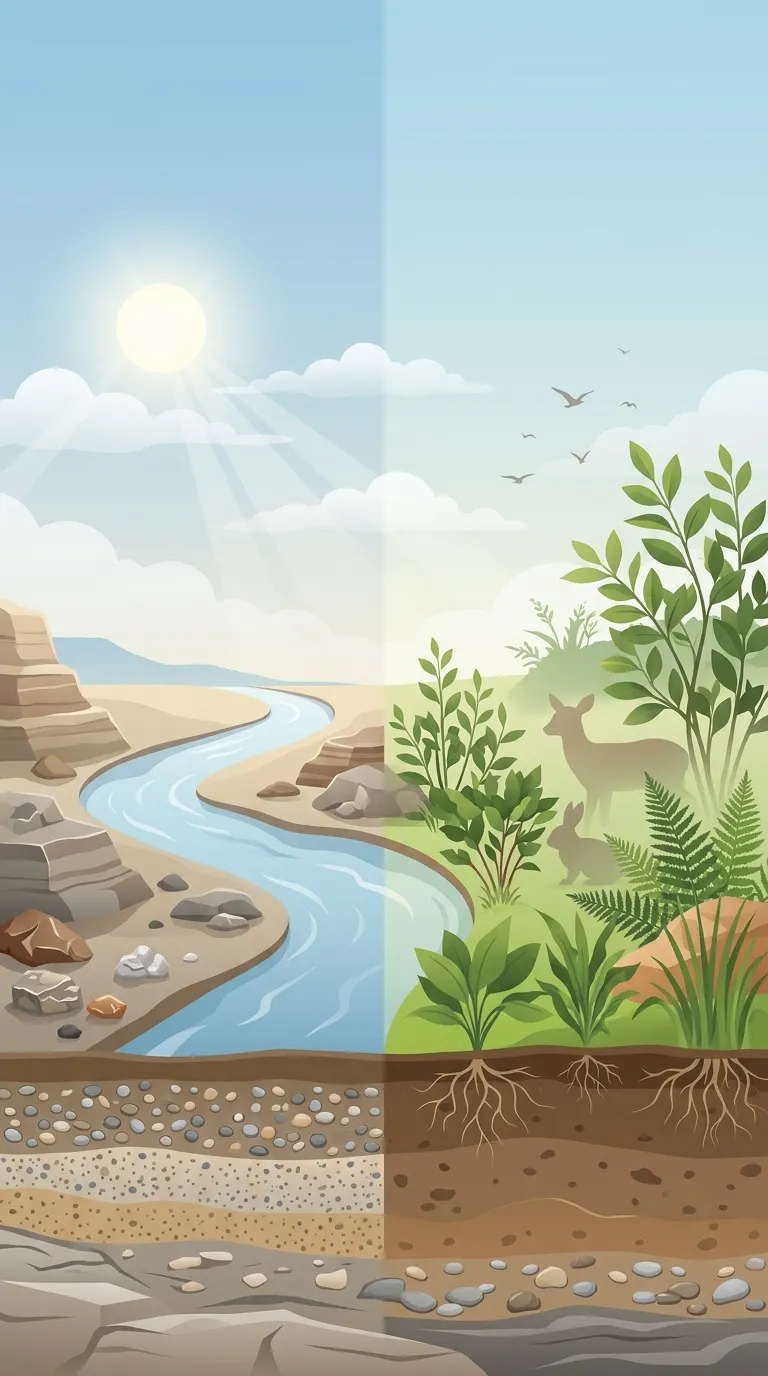
Abiotic has one core meaning: not alive, or not produced by living things. But writers use it in three different settings, and each setting calls for different synonyms. In ecology it describes the physical conditions of an environment.
In chemistry and geology it describes things formed without life.Eeveryday language it simply means nonliving. Each setting has its own related words, covered separately below.
What Does Abiotic Mean? (All Three Contexts)
Most people know about abiotics only from school biology. In practice, three uses are common.
Meaning 1: Nonliving parts of an environment (ecology and biology). The physical and chemical conditions that shape life, such as sunlight, temperature, water, air, and soil minerals. Example: Temperature and rainfall are abiotic factors that decide which plants can grow in a region.
Meaning 2: Formed without life (chemistry, geology, astrobiology). A substance or process that arises with no help from living organisms. Example: Scientists tested whether the methane on the planet came from an abiotic process or from microbes.
Meaning 3: Simply not alive (general use). Any object or material that has no life in it. Example: A stone is an abiotic object, while a beetle is not.
The word comes from the prefix a-, meaning “without,” and biotic, meaning “relating to life.” So the literal meaning is “without life.” Each context needs its own vocabulary, and mixing them up creates confusion fast.
SECTION 1: SYNONYMS FOR ABIOTIC (ECOLOGY AND BIOLOGY)
Category A: Plain, Everyday Words
Nonliving – Not alive and never part of a living organism. Rocks, water, and sunlight are the nonliving parts of an ecosystem.
Not alive – The simplest possible phrase, good for young readers. The teacher asked students to sort the items into alive and not alive.
Without life – A plain phrase that mirrors the word’s origin. The surface of the moon is without life.
Inanimate – Not alive and unable to move or act on its own. Children learn early to tell animate creatures from inanimate objects.
Lifeless – Containing no living things. The salt flat looked lifeless under the midday sun.
Category B: Scientific and Academic Terms
Nonbiological – Not related to or produced by biology. Researchers looked for a nonbiological explanation for the pattern.
Nonbiologic – A less common spelling of nonbiological. The sample showed nonbiologic mineral growth.
Physical factors – A common way to describe abiotic conditions in an ecosystem. Physical factors such as light, heat, and moisture control where species can live.
Nonliving components – A textbook phrase for the abiotic parts of a habitat. Soil, air, and water are the nonliving components of a pond.
Environmental conditions – A broader phrase that includes abiotic factors. Environmental conditions in the desert are harsh and dry. Note that this phrase can also include living factors, so it is less precise.
Category C: Informal and Classroom Terms
Nonliving things – A common school-level label. Make a list of living and nonliving things you see in the garden.
Natural elements – A casual way to refer to sun, wind, water, and soil. Natural elements shape the way a river valley forms.
Inanimate matter – A formal phrase used in some textbooks. All life depends on inanimate matter such as minerals and water.
SECTION 2: SYNONYMS FOR ABIOTIC (CHEMISTRY, GEOLOGY, AND ASTROBIOLOGY)
This meaning focuses on how something was formed, not just whether it is alive.
Abiogenic – Produced by processes that do not involve life. Some of the oil and gas on Earth may be abiogenic in origin.
Nonbiogenic – Not generated by living organisms. The team confirmed that the minerals were nonbiogenic.
Inorganic – Not containing carbon-hydrogen structures typical of living matter. This is the most common chemistry alternative. Salt and iron are inorganic compounds found in soil.
Azoic – A rare geology term meaning without any trace of life. Early geologists described the oldest rock layers as azoic.
Mineral – Naturally occurring and not derived from living things. The mineral content of the water was tested. This works as a loose synonym only when talking about composition.
Prebiotic – Relating to the conditions before life began. Not a true synonym, but often used nearby. Prebiotic chemistry studies how simple molecules formed before life existed.
Example in context: The crystals formed through an abiogenic process, so the scientists ruled out any link to microbial life.
SECTION 3: SYNONYMS FOR ABIOTIC (EVERYDAY AND LITERARY USE)
Inanimate object – Any item that is not alive. The photograph captured only inanimate objects, with no people in view.
Lifeless – Showing no sign of life. The planet appeared lifeless from orbit.
Barren – Unable to support life, often used for land. The barren plain stretched for miles. This describes a condition, not an origin, so use it only for landscapes.
Sterile – Free of living organisms such as germs. The tools were kept in a sterile container. This is close in feeling but different in meaning, since sterile things were cleaned, not originally nonliving.
Dormant – Not currently active, but still alive. Seeds can stay dormant for years. Included only as a warning. Dormant things are alive, so they are not abiotic.
WORDS THAT LOOK LIKE SYNONYMS BUT ARE NOT
Many thesaurus sites list words that are only loosely related. These can make your sentence scientifically wrong.
Dead – Something that was once alive and no longer is. A fallen log is dead, but a rock is abiotic. In ecology, dead organic matter is usually grouped with biotic material because it came from living things.
Inert – Chemically inactive or unable to move. Helium is an inert gas, but “inert” does not mean “not alive.” Use it only when you mean “does not react.”
Insentient / Insensate – Unable to feel or sense. A rock is insentient, but so might be a simple organism in some definitions. It describes sensation, not life.
Soulless / Spiritless – Emotional words describing people or performances. They have no scientific meaning here.
Wooden / Cold / Mechanical / Vacant – Style or personality words. Avoid them in any science context.
Extinct – A species that no longer exists. Extinct things were once alive, so they are not abiotic.
EXAMPLES OF ABIOTIC FACTORS
Knowing real examples makes the word easier to use correctly.
Sunlight – The main energy source for most ecosystems. Plants in the forest canopy receive more sunlight than those on the ground.
Temperature – Controls which species can survive in a place. Many coral species cannot survive a rise in water temperature.
Water – Includes rain, rivers, lakes, and humidity. Water availability determines whether a region is a desert or a rainforest.
Air and gases – Oxygen, carbon dioxide, and nitrogen. Oxygen levels drop at high altitude.
Soil and minerals – Provide nutrients to plants. Sandy soil holds less water than clay soil.
pH – The acidity or alkalinity of soil and water. Acid rain lowered the pH of the lake.
Salinity – The salt level in water or soil. Salinity changes as a river meets the sea.
Wind – Affects pollination, seed spread, and evaporation. Strong wind shaped the trees along the coast.
Pressure – Matters in deep oceans and high mountains. Deep-sea animals are adapted to extreme pressure.
Topography – The shape of the land, including slopes and altitude. Topography affects how water flows through a valley.
ABIOTIC VS BIOTIC VS INORGANIC VS INANIMATE
Abiotic vs biotic. It means nonliving. Biotic means living or produced by living things. Ecosystems need both. Plants need abiotic sunlight and water, and animals need biotic plants for food.
Abiotic vs inorganic. These overlap but are not identical. Inorganic is mainly a chemistry term about composition. Abiotic is mainly an ecology term about life. Methane can form abiotically, yet many chemists call it organic.
Abiotic vs inanimate. Inanimate usually describes objects, such as a chair or a stone. Abiotic usually describes environmental factors or processes, such as temperature or erosion.
Abiotic vs dead.Dead things once were.
A simple rule: use abiotic for conditions and processes, inorganic for chemical makeup, and inanimate for objects.
HOW TO PICK THE RIGHT WORD
Ask who is reading first. For students and general readers, use nonliving or not alive. For researchers, use nonbiological or abiotic itself.
Then ask what you want to stress. If you want to stress where something came from, use abiogenic. If you want to stress chemistry, use inorganic.
The three contexts rarely collide in real writing, so the setting usually makes the choice easy.
COMMON MISTAKES TO AVOID
Don’t use “dead” as a synonym. Dead things were alive earlier, and abiotic things were not.
Don’t use “inert” in ecology. It describes chemical reactivity, not life.
Don’t assume inorganic always equals abiotic. They overlap, but they come from different fields.
Don’t use emotional words like “soulless” or “spiritless” in scientific writing.
Don’t use rare words like “azoic” for a general audience. Readers will not recognize them.
Don’t swap “abiotic” for “environmental” when you mean only the nonliving parts. Environment also includes living things.
ANTONYMS OF ABIOTIC
Biotic – Relating to living things. Predators and prey are biotic factors in a food web.
Living – Alive and able to grow or reproduce. The reef is a living system.
Animate – Alive and able to move or act. Animate creatures respond to their surroundings.
Organic – Derived from living matter, in many contexts. Organic material in soil comes from decayed plants.
Alive – Showing signs of life. The garden was alive with insects.
Biological – Relating to living organisms. The lab studied the biological response to heat.
RELATED WORDS WORTH KNOWING
Abiotically – In a way that does not involve living things. The compound formed abiotically in the early Earth.
Abiogenesis – The idea that life arose from nonliving matter. Abiogenesis research asks how the first cells began.
Biotope – A habitat defined by its living and nonliving features. The pond is a small biotope.
Edaphic – Relating to soil. Edaphic factors include soil texture and pH.
Ecosystem – A community of living and nonliving things interacting. A forest is an ecosystem.
Habitat – The place where an organism lives. The wetland is a habitat for many birds.
Biome – A large region defined by climate and typical life. The tundra is a cold biome.
FREQUENTLY ASKED QUESTIONS
What is another word for abiotic?
The most common alternatives are nonliving, inanimate, inorganic, and nonbiological.
What is the opposite of an abiotic?
The opposite is biotic, meaning living or produced by living things.
Is death the same as abiotic?
No. Dead means something was once alive. Abiotic means it was never alive, or it was not produced by life.
Is inorganic the same as abiotic?
Not exactly. Inorganic is mostly a chemistry term. Abiotic is mostly an ecology term. They overlap, but they are not identical.
Is water abiotic?
Yes. Water is nonliving, even though every living thing needs it.
Is a dead tree abiotic?
Usually not. It came from a living organism and feeds decomposers, so it is generally treated as biotic matter.
What are the main abiotic factors?
Sunlight, temperature, water, air, soil, minerals, pH, salinity, wind, and pressure.
Which synonym is best for school writing?
Nonliving is the clearest and safest choice.
Can abiotic be used as a noun?
Rarely. It is usually an adjective, as in “abiotic factors.” People sometimes say “the abiotic” to mean the nonliving part of a system, but this is uncommon.
Why does the word have more than one use?
It is a scientific term borrowed from many fields. Ecology, geology, and chemistry each use it in a slightly different way, so context decides the best synonym.
FINAL THOUGHT
Abiotic is not just one word with one setting. It shifts slightly depending on the field: ecology, geology, or everyday speech.
Picking the right synonym starts with picking the right context first. Get that right, and the correct word follows naturally.

I’m William Parker, an English language enthusiast and content writer with a passion for words and clear communication. I specialize in writing well-researched content about synonyms, vocabulary, grammar, and word meanings. My goal is to help students, writers, and English learners expand their vocabulary and choose the right words with confidence. I believe learning English should be simple, practical, and enjoyable for everyone.