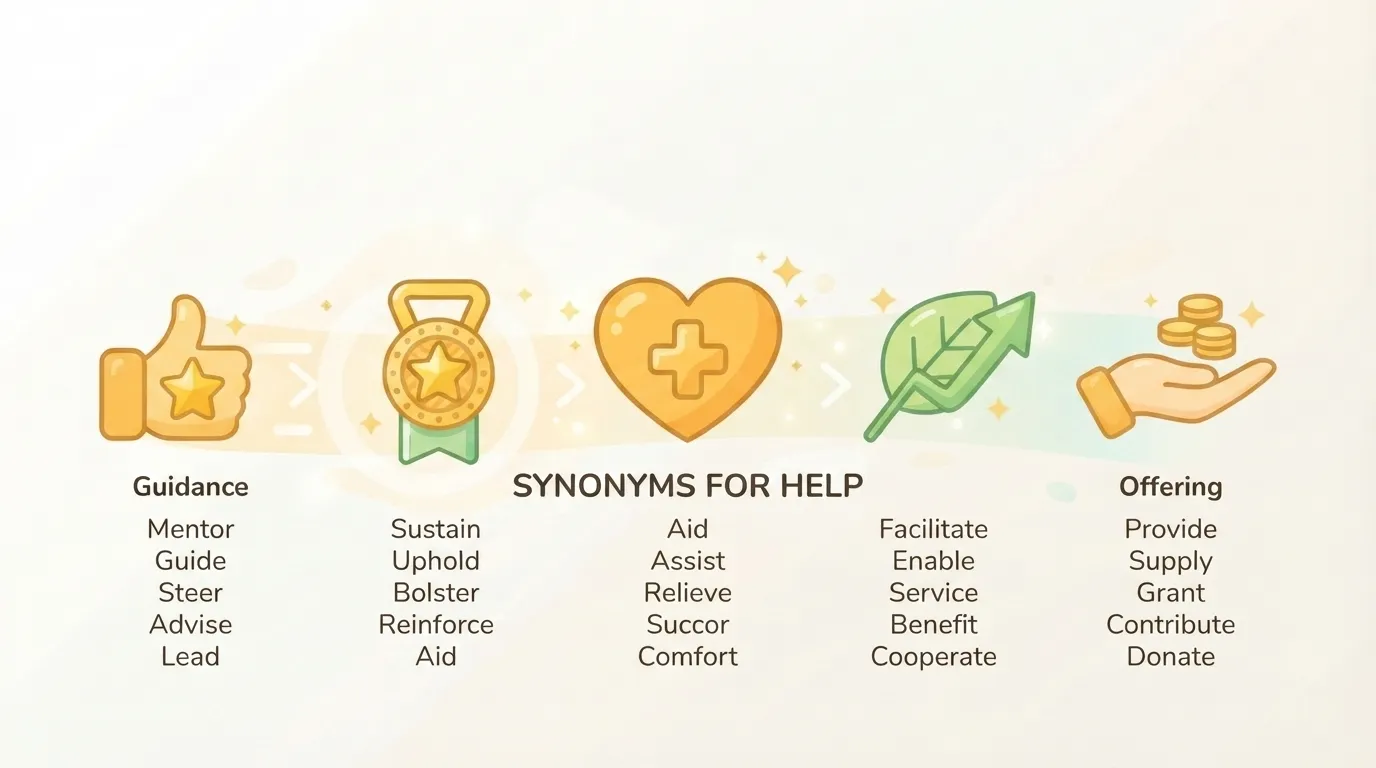
“Help” is one of the most commonly used words in the English language. Whether you’re writing an email, building a resume, drafting an essay, or simply having a casual conversation, “help” shows up everywhere.
The problem is that when the same word is repeated over and over, your writing starts to feel weak, monotonous, and unpolished.
In this article, we’ll explore virtually every possible synonym for “help” as a verb, as a noun, in formal and informal contexts, for resumes, for academic writing, and for everyday conversation.
Each section includes the meaning, appropriate context, and example sentences so you can choose the right word without confusion.
The Basic Meaning of “Help”
Before diving in, it’s worth understanding how many ways “help” is actually used:
- As a verb — to assist someone, to make a task easier for them
- As a noun — assistance, support, aid
- As an interjection — when someone is in danger and cries out for help (“Help! Help!”)
- In the sense of “domestic worker” — this usage is outdated and now carries a negative connotation, so words like “staff,” “employee,” or “domestic worker” are better choices in this context.
Now let’s look at each category in detail.
Synonyms for “Help” as a Verb
When “help” means physically or practically assisting someone, these synonyms work well:
- Assist — Used for formal or official help. E.g., “The nurse assisted the doctor during the surgery.”
- Aid — Used in more serious or emergency situations. E.g., “The government sent aid to the flood victims.”
- Support — Used for emotional or financial backing. E.g., “She supported her brother through his illness.”
- Lend a hand — Casual, friendly help. E.g., “Could you lend me a hand with these boxes?”
- Facilitate — To make something easier or possible. E.g., “The new software facilitates faster communication.”
- Back — To support someone through action or money. E.g., “The investors backed the new startup.”
- Boost — To lift someone up or encourage them. E.g., “The bonus boosted employee morale.”
- Contribute — To give financial or material help. E.g., “Everyone contributed to the relief fund.”
- Cooperate — To work together toward a common goal. E.g., “The two departments cooperated to finish the project.”
- Guide — To offer direction or share experience. E.g., “The mentor guided the new employees.”
- Advise — To give recommendations. E.g., “The lawyer advised him on his legal rights.”
- Care for — To look after someone, especially in illness or need.
- Rescue — To save someone from danger. E.g., “Firefighters rescued the trapped family.”
- Pitch in / Chip in — To contribute effort to a task. E.g., “We all pitched in to clean the office.”
- Abet — To actively help with an endeavor (often used in negative contexts too). E.g., “He was accused of abetting the crime.”
- Accommodate — To meet someone’s needs. E.g., “The hotel accommodated our special requests.”
- Bolster — To strengthen something. E.g., “The new evidence bolstered the case.”
- Buttress — To support or strengthen. E.g., “The report buttresses our argument.”
- Champion — To advocate for a cause. E.g., “She has always championed women’s rights.”
- Encourage — To inspire or motivate. E.g., “Teachers should encourage creativity in students.”
- Foster — To help something develop. E.g., “The program fosters innovation among students.”
- Nurture — To help someone or something grow gradually. E.g., “Good parents nurture their children’s talents.”
- Mentor — To provide guidance and experience, especially in a career. E.g., “She mentors young professionals in her field.”
- Intercede — To speak on someone’s behalf. E.g., “He interceded on behalf of his colleague.”
- Minister to — To attend to someone’s physical or emotional needs. E.g., “The volunteers ministered to the refugees.”
Synonyms in the Sense of “Improve” or “Make Better”
When “help” means making something better, use these instead:
- Ameliorate — To make difficult circumstances more tolerable. E.g., “The new policy aims to ameliorate poverty.”
- Alleviate — To reduce pain or hardship. E.g., “The medicine helped alleviate her pain.”
- Ease — To make something easier. E.g., “Deep breathing can ease anxiety.”
- Enhance — To increase quality or value. E.g., “The new features enhance the user experience.”
- Relieve — To reduce a burden or discomfort. E.g., “The painkillers relieved his headache.”
- Mitigate — To reduce the severity of harm. E.g., “These steps will help mitigate climate change.”
- Remedy — To fix a problem. E.g., “The company remedied the software bug quickly.”
- Palliate — To reduce symptoms without curing the root cause. E.g., “The treatment only palliates the symptoms.”
- Cure — To completely fix. E.g., “The new drug cures the infection completely.”
- Heal — To recover from injury or illness. E.g., “Time heals most emotional wounds.”
Synonyms for “Help” as a Noun
When “help” functions as a noun in a sentence:
- Assistance — The closest and most formal synonym. E.g., “Thank you for your assistance.”
- Aid — Official or emergency help. E.g., “The organization provides aid to disaster victims.”
- Support — Emotional or financial backing. E.g., “I appreciate your support during this difficult time.”
- Relief — Comfort from hardship. E.g., “The news brought great relief to the family.”
- Guidance — Direction or advice. E.g., “Students need guidance when choosing a career.”
- Backing — Encouragement or support. E.g., “The project has the full backing of the management.”
- Cooperation — The act of working together. E.g., “We need the cooperation of all team members.”
- Comfort — Emotional support or consolation. E.g., “Her presence gave him great comfort.”
- Service — Working for or benefiting someone. E.g., “The volunteers offered their services to the community.”
- Boost — Something that lifts progress or morale. E.g., “The award was a huge boost to her career.”
Strong Action Verbs for Resumes and Professional Writing
“Help” is often considered a weak word on resumes because it’s vague — it doesn’t clarify exactly what you did. Instead, use these strong, specific action verbs:
- Facilitated — e.g., “Facilitated weekly team meetings to improve communication.”
- Coordinated — e.g., “Coordinated logistics for a 200-person conference.”
- Supported — e.g., “Supported the marketing team in launching three new campaigns.”
- Contributed to — e.g., “Contributed to a 15% increase in customer satisfaction.”
- Streamlined — e.g., “Streamlined the onboarding process for new employees.”
- Enabled — e.g., “Enabled faster decision-making through data automation.”
- Drove — e.g., “Drove a 20% growth in quarterly sales.”
- Collaborated — e.g., “Collaborated with cross-functional teams to deliver the project on time.”
- Spearheaded — e.g., “Spearheaded the company’s first sustainability initiative.”
- Championed — e.g., “Championed diversity hiring practices across departments.”
These verbs are more specific and tell recruiters exactly what you achieved, instead of the vague “helped.”
Synonyms for “Helper”
If you’re describing a person who provides help:
- Assistant — A general office or personal helper
- Aide — Especially in healthcare or political contexts
- Apprentice — Someone working in order to learn
- Deputy — Someone who fills in for a senior role
- Right-hand person — The most trusted helper
- Volunteer — Someone who helps without pay
- Collaborator — Someone who works jointly on a project
- Ally — Someone who offers support or backing
- Partner — Someone who works as an equal
Synonyms for “Helpful”
When describing a person, thing, or piece of advice that is helpful:
- Supportive — Emotionally helpful. E.g., “My colleagues have been very supportive.”
- Useful — Practically beneficial. E.g., “This tool is extremely useful.”
- Valuable — Important and worthwhile. E.g., “Her feedback was valuable to the project.”
- Beneficial — Advantageous. E.g., “Regular exercise is beneficial for health.”
- Accommodating — Consider others’ needs. E.g., “The staff was very accommodating.”
- Considerate — Mindful of others’ feelings. E.g., “He is always considerate of others’ feelings.”
- Constructive — Beneficial and improvement-oriented. E.g., “She gave constructive criticism.”
- Instrumental — Playing a key role in an achievement. E.g., “He was instrumental in closing the deal.”
Idioms and Phrasal Verbs That Can Replace “Help”
In informal or conversational writing, these idioms are very effective:
- Be of use / Be of service — E.g., “Let me know if I can be of any use.”
- Go to bat for — To stand up in support of someone. E.g., “My manager went to bat for me during the review.”
- Stand by — To remain supportive during hard times. E.g., “I’ll stand by you no matter what.”
- Take under one’s wing — To mentor and protect someone. E.g., “The senior developer took the intern under his wing.”
- Root for — To wish for someone’s success and support them. E.g., “We’re all rooting for you.”
- Give a leg up — To help someone get ahead. E.g., “This internship gave her a leg up in the industry.”
- Bail someone out — To rescue someone from a difficult situation. E.g., “He bailed his friend out of a tough situation.”
- Do a favor — To do something for someone. E.g., “Could you do me a favor and check this email?”
Antonyms — Words That Are the Opposite of “Help”
Sometimes you need the opposite of “help” — for example, when writing about an obstacle or something harmful:
- Hinder
- Obstruct
- Impede
- Hamper
- Prevent
- Discourage
- Undermine
- Sabotage
- Block
E.g., “Poor communication can hinder team productivity.”
How to Choose the Right Synonym for the Context
This is the most important part — not every synonym is an exact replacement for “help.” Here are a few key points to keep in mind:
- “Support” vs. “Aid”: “Support” carries more emotional weight and suggests a longer-term relationship. “Aid” is more formal, official, and typically used in emergency or disaster situations.
- “Facilitate” vs. “Assist”: “Facilitate” means making a process easier — it’s not direct, hands-on help. “Assist” means you’re directly working alongside someone.
- “Alleviate” is only for negative situations: You can’t say “alleviate happiness” — it’s only used for reducing pain, hardship, or stress.
- Formal vs. Informal: In academic or business writing, “assist,” “facilitate,” and “contribute” work better. In casual conversation, “lend a hand,” “pitch in,” and “help out” sound more natural.
- Specificity matters on a resume: Instead of writing “helped the team,” specify exactly what you did — verbs like “coordinated,” “streamlined,” or “facilitated” are far more impactful.
Common Mistakes People Make
- Using “support” everywhere instead of “help” — when sometimes “assist” or “aid” would be more appropriate.
- Using “alleviate” with positive things — this word is only for negative situations (pain, hardship).
- Repeating “helped” throughout a resume — this makes your achievements sound generic. Every bullet point should use a different, strong verb.
- Using idioms in formal writing — phrases like “lend a hand” sound out of place in a business report, where “provide assistance” is more appropriate.
Conclusion
“Help” is a simple yet powerful word, but repeating it too often can make your writing feel weak, dull, and generic. Whether you’re writing a professional resume, an academic paper, a business email, or simply messaging a friend, choosing the right synonym makes your writing more polished, precise, and impactful.
The synonyms covered above assist, aid, support, facilitate, alleviate, ameliorate, contribute, along with idioms like “lend a hand” and “go to bat for” now give you a complete vocabulary to choose the right word depending on context.

I’m William Parker, an English language enthusiast and content writer with a passion for words and clear communication. I specialize in writing well-researched content about synonyms, vocabulary, grammar, and word meanings. My goal is to help students, writers, and English learners expand their vocabulary and choose the right words with confidence. I believe learning English should be simple, practical, and enjoyable for everyone.