Type “iconic” into any thesaurus and you’ll get a wall of 600+ words with zero guidance on which one to actually use. That’s the real problem people run into not a lack of synonyms, but not knowing which synonym fits which sentence.
Use the wrong one and a sentence meant to sound powerful ends up sounding like every other headline online. This guide fixes that, word by word.
What Does “Iconic” Actually Mean?
Iconic (adjective): widely recognized as a symbol of a particular time, culture, movement, or achievement, something so familiar it has become a reference point in itself.
The word comes from icon, originally a religious image in Eastern Christian art meant to represent something sacred. By the 20th century, “icon” had broadened to mean any person, object, or image that stands for a bigger idea, think the Statue of Liberty standing for freedom, or a red London phone box standing for Britain. “Iconic” is simply the adjective form: it describes something that has reached icon status.
Three things separate “iconic” from ordinary fame:
- Recognition most people can identify instantly, even without context.
- Representation stands for something larger than itself (an era, a brand, a movement).
- Endurance stays recognizable over time, not just for one news cycle.
That third point is why “iconic” and “famous” aren’t interchangeable, even though most thesaurus lists treat them as equals. More on that below.
Where the Word Comes From
The root, icon, traces back to the Greek word eikōn, meaning “image” or “likeness.” For centuries it was mostly a religious term describing painted images of saints.
The word crossed into everyday English usage in the 20th century, when advertising, film, and mass media needed a way to describe images and figures that everyone instantly recognized: a Coca-Cola bottle, a Marilyn Monroe photograph, a Nike swoosh.
Once “icon” became common as a noun for these cultural symbols, “iconic” followed naturally as its adjective form. That history is part of why the word still carries weight: it was borrowed from something sacred to describe something the culture treats as almost untouchable.
Iconic Meaning Synonyms: Quick Answer
If you only came for a fast list, here it is. For everyday writing, the closest, most natural synonyms for iconic are:
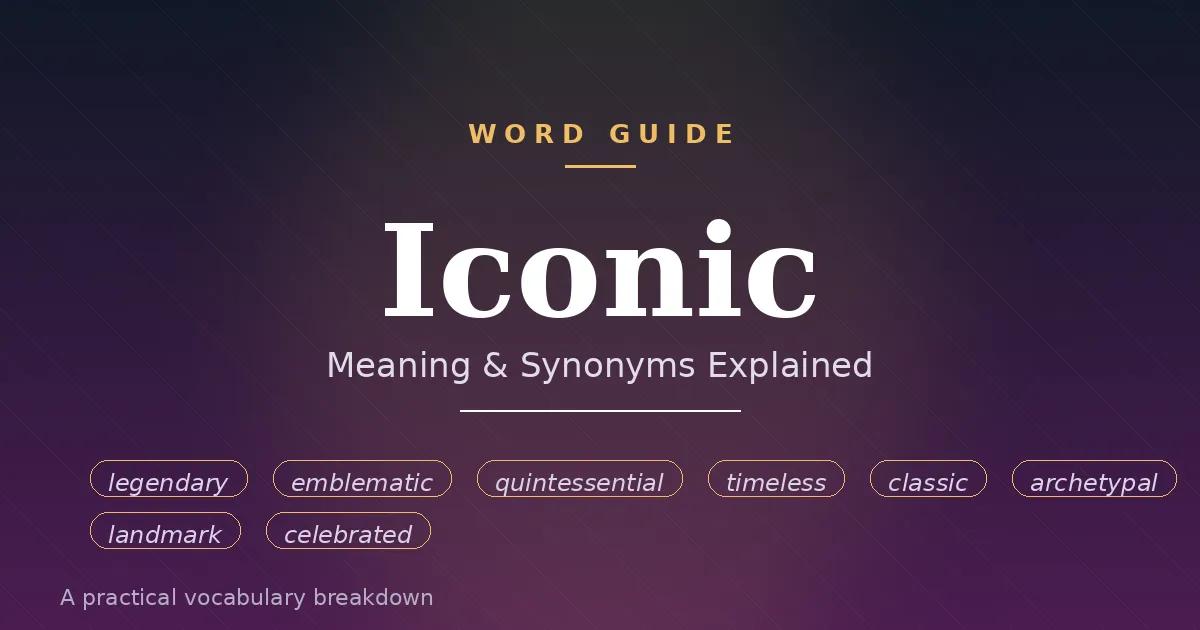
Legendary, classic, emblematic, quintessential, landmark, timeless, celebrated, renowned, archetypal, and symbolic.
Now here’s what most synonym lists skip: these words are not interchangeable. Each carries a slightly different shade of meaning, and picking the wrong one can quietly change what your sentence implies.
Synonyms for Iconic, Grouped by What They Actually Mean
Instead of dumping 50 words on you, here’s every major synonym sorted by the specific meaning it adds so you can pick by intent, not by guesswork.
Words That Emphasize “Symbol of Something Bigger”
- Emblematic is used when the thing represents an abstract idea or cause. “The raised fist became emblematic of the resistance.”
- Symbolic broader and more neutral than emblematic; works in formal or academic writing.
- Representative best when comparing one example to a whole category.
Word That Emphasize “Best Example of Its Kind”
- Quintessential the purest, most typical example. “A quintessential 90s sitcom.”
- Archetypal implies it sets the pattern others copied.
- Prototypical closer to technical/academic tone; common in design and psychology writing.
Words That Emphasize “Lasting Fame”
- Legendary leans toward admiration and storytelling, slightly more casual.
- Timeless focuses on the fact that it hasn’t aged, not necessarily that it’s a symbol.
- Celebrated formal, often used in obituaries, reviews, and awards writing.
- Renowned closer to “famous for skill or achievement” than “symbol of an era.”
Words That Are Weaker Substitutes (Use With Caution)
- Famous just means widely known. It says nothing about representing anything, so swapping it for “iconic” can flatten your meaning.
- Well-known even weaker than famous; fine for neutral writing, wrong for anything that needs impact.
- Popular measures current liking, not lasting symbolic status. A song can be popular for a week and never become iconic.
This is the gap most synonym pages miss entirely: they list “famous” and “popular” right next to “legendary” and “archetypal” as if they mean the same thing. They don’t, and using them interchangeably is one of the most common writing mistakes tied to this word.
Iconic vs. Its Closest Synonyms: Side-by-Side Comparison
| Word | Core Meaning | Best Used For | Tone |
| Iconic | Recognized symbol of a time/culture | People, brands, landmarks, moments | Neutral–strong |
| Legendary | Famous through stories over time | Athletes, musicians, myths | Warm, admiring |
| Classic | Enduringly good, standard of its type | Films, cars, recipes, fashion | Neutral, timeless |
| Emblematic | Represents an abstract idea | Movements, causes, political moments | Formal |
| Quintessential | The purest example of a category | Describing “the most typical X” | Formal–academic |
| Famous | Widely known | Anything, without added meaning | Neutral, weaker |
| Landmark | A defining, turning-point achievement | Events, decisions, buildings | Formal |
| Timeless | Doesn’t feel dated | Design, style, art | Neutral, elegant |
Quick rule: if you can replace “iconic” with “famous” and the sentence loses nothing, you didn’t need “iconic” in the first place, you needed “famous.” If replacing it with “famous” makes the sentence feel weaker or vaguer, “iconic” (or one of its stronger synonyms) is doing real work.
Real Examples: Iconic and Its Synonyms in Context
- Iconic: “The Hollywood sign is one of the most iconic images in American pop culture.”
- Legendary: “Muhammad Ali’s legendary rivalry with Joe Frazier defined a decade of boxing.”
- Classic: “The little black dress is a classic piece every wardrobe needs.”
- Emblematic: “The falling of the Berlin Wall became emblematic of the end of the Cold War.”
- Quintessential: “Central Perk is the quintessential 90s coffee-shop hangout.”
- Landmark: “The 1969 moon landing was a landmark moment in space exploration.”
- Timeless: “Audrey Hepburn’s style remains timeless decades later.”
Notice how each sentence would lose precision if you swapped in a random synonym. “Legendary” fits Ali because it implies stories passed down over time “iconic” would work too, but “famous” would flatten the sentence completely.
Common Mistakes People Make With “Iconic”
1. Overusing it as filler praise. “Iconic” has become a default hype word used for a coffee mug, a TikTok trend, a Tuesday. Style guides and editors increasingly flag it as overused, the same way “amazing” and “epic” got worn out. If everything is iconic, nothing is.
2. Using it for anything simply popular right now. A trending song is not automatically iconic. Iconic requires staying power. Wait for the test of time before applying the word or use “popular” or “trending” instead, which are honest about the timeframe.
3. Treating “famous” and “iconic” as the same word. As shown in the comparison table above, “famous” only means widely known. “Iconic” means widely known and symbolic of something larger. Mixing them up weakens formal writing especially.
4. Applying it to things with no cultural or symbolic weight. “An iconic Tuesday sandwich” is a joke, not a description. Reserve “iconic” (and its stronger synonyms) for things that genuinely represent a place, era, or idea.
5. Choosing a synonym by “sounds fancy” instead of by meaning. Writers often reach for “quintessential” or “archetypal” simply because they sound more sophisticated than “iconic,” without checking whether the meaning actually fits. “Quintessential” means the purest example of a category; it’s the wrong choice for describing something that merely became widely recognized without setting a pattern others followed. When in doubt, go back to the comparison table above and match the meaning first, tone second.
Pro Tips for Choosing the Right Synonym
- Writing a headline or hook? Using “iconic” or “legendary” both carry built-in emotional pull.
- Writing formally (essays, reports, journalism)? Prefer “emblematic,” “landmark,” or “quintessential” they read as more precise and less like marketing language.
- Describing a person’s achievement, not just fame? Use “renowned” or “celebrated” instead of “iconic,” since those words carry a sense of earned respect.
- Not sure if something has truly earned “iconic” status? Ask: would most people recognize this without extra explanation, and does it represent something bigger than itself? If either answer is no, pick a lighter word like “popular” or “well-known.”
- Avoid stacking synonyms in the same paragraph. Pick one dominant word per idea; repeating five near-synonyms in three sentences reads as padding, not vocabulary.
Frequently Asked Questions
Iconic Meaning and Synonyms in English
“Iconic” describes someone or something that is widely recognized and strongly associated with a particular time, place, or culture. Common synonyms include famous, legendary, celebrated, renowned, and memorable.
Real-life example:
The Statue of Liberty is an iconic symbol of freedom in the United States.
Iconic Meaning, Synonyms, and Antonyms
The word “iconic” usually means very famous, easily recognized, or highly influential. Its synonyms include legendary, famous, celebrated, and renowned, while antonyms can include unknown, obscure, and unremarkable.
Real-life example:
Michael Jackson is considered an iconic musician, while an unknown local performer would not usually be described that way.
Iconic Synonyms in Slang
In casual speech, people often use words such as legendary, classic, epic, or unforgettable instead of “iconic.” These words can make a sentence sound more relaxed and conversational.
Real-life example:
“That outfit was legendary!” is a casual way of saying the outfit was especially memorable or iconic.
Iconic Antonyms
An antonym of “iconic” describes something that is not well known, memorable, or important. Useful opposites include ordinary, unknown, obscure, forgettable, and insignificant.
Real-life example:
While the Eiffel Tower is iconic, a small building that few people recognize could be described as ordinary or unremarkable.
Another Word for an Iconic Person
When describing an iconic person, you can use words such as legend, celebrity, star, pioneer, trailblazer, or influential figure. The best choice depends on why the person is considered iconic.
Real-life example:
Nelson Mandela can be described as a legendary leader because of his major influence on South Africa’s history.
Formal Synonyms for Iconic
For formal writing, alternatives such as renowned, distinguished, celebrated, legendary, and highly influential often work better than casual words like “epic” or “cool.”
Real-life example:
“Martin Luther King Jr. was a highly influential figure in the civil rights movement” sounds more formal than simply calling him “iconic.”
Synonyms for Icon
“Icon” refers to a person, symbol, image, or thing that is widely recognized and represents an important idea. Depending on the context, synonyms include symbol, emblem, figure, representation, celebrity, and legend.
Real-life example:
The dove is widely recognized as a symbol of peace.
Final Thoughts
“Iconic” isn’t just a fancier word for “famous” , it’s a specific claim that something represents a moment, culture, or idea larger than itself.
The synonyms around it (legendary, emblematic, quintessential, classic, timeless) each carry their own shade of that claim, and picking the right one is less about sounding impressive and more about saying exactly what you mean.
Next time you reach for “iconic,” pause for a second and ask what you’re really trying to say: recognition, symbolism, or simple fame and let that answer choose your word.

I’m William Parker, an English language enthusiast and content writer with a passion for words and clear communication. I specialize in writing well-researched content about synonyms, vocabulary, grammar, and word meanings. My goal is to help students, writers, and English learners expand their vocabulary and choose the right words with confidence. I believe learning English should be simple, practical, and enjoyable for everyone.