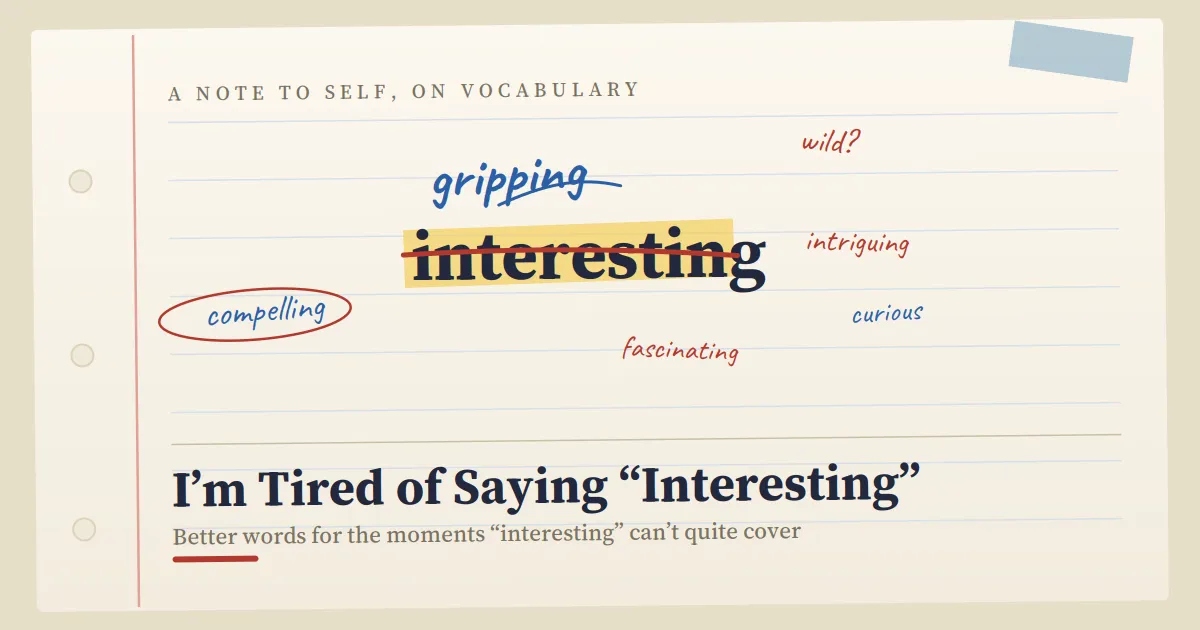
Good alternatives to “interesting” include curious and amusing (mildly interesting), fascinating, gripping, and captivating (strongly interesting), compelling and noteworthy (formal), wild and cool (casual), and intriguing (mysterious or curiosity-driven).
The best synonym depends on how strong the interest actually is and where you’re using it: casual chat, an essay, a review, or work writing.
I noticed it in the middle of a text conversation last week. My friend sent me a voice note about her new job, and I typed back: “wow that’s so interesting.”
Then I scrolled up and saw I’d said the exact same thing about a documentary an hour earlier. And a podcast the day before that. And, if I’m honest, probably every single thing anyone has told me for the last several years.
“Interesting” had basically become my default response to life. Someone tells me a wild story from their childhood? Interesting. Someone explains a complicated theory about black holes? Interesting. Someone tells me their cat learned to open doors?
Also, somehow, interesting. At some point the word stopped meaning anything at all. It became the verbal equivalent of nodding along in a meeting when you weren’t really listening.
So I started paying attention to how often I leaned on it, and honestly, it was embarrassing. That’s what pushed me to actually sit down and figure out what I could say instead not just as a list to skim, but words I could genuinely picture using in real sentences, in real conversations, without sounding like I swallowed a thesaurus.
Why “Interesting” Feels So Weak
Here’s the thing about “interesting” : it doesn’t commit to anything. It’s the word you use when you don’t want to reveal how you actually feel. Think about it: if a coworker shows you their new business idea and you say “that’s interesting,” what do they hear? Probably not enthusiasm. It’s the vocabulary version of a shrug.
The word also does this weird job of covering every possible type of attention-grabbing, which means it ends up describing nothing specific. A gripping crime documentary and a mildly odd fact about octopuses are not the same kind of interesting, but “interesting” treats them identically. It flattens everything into one beige, safe reaction. Once I noticed that, I couldn’t unnoticed it, and I got a little obsessed with fixing it.
The Words I Actually Started Using
I didn’t want a giant, overwhelming list of 100 synonyms I’d never remember. I wanted a small mental shelf of words sorted by how strong the feeling actually was, so I could just reach for the right one without thinking too hard. Here’s how I ended up grouping them.
When something is only a little bit interesting
This is for the “huh, neat” reaction. Not life-changing, just mildly worth mentioning.
Curious, amusing, quirky, appealing, notable, worth a look.
I use “curious” a lot now for small odd things like a curious little café I walked past, or a curious detail in a news article. It sounds observant without pretending to be impressed.
When something completely grabs me
This is the good stuff when I actually can’t stop thinking about whatever it is.
Fascinating, captivating, gripping, riveting, absorbing, spellbinding, enthralling.
I’ve started saving “gripping” specifically for shows or books that genuinely keep me up too late. It has weight to it. Saying “gripping” about a lecture on tax law would feel like a lie, and that’s exactly the point these words are supposed to mean something.
When I need to sound like I know what I’m talking about (formal)
For emails, essays, anything where I need to sound put-together.
Compelling, noteworthy, thought-provoking, significant, illuminating, insightful.
“Compelling” has basically replaced “interesting” in anything I write for work. It sounds like I have an actual opinion instead of just a vague reaction.
When I’m just talking to friends (casual)
For texting, group chats, real conversation.
Wild, cool, fun, sick, out there, juicy.
I’ll admit “wild” has become my most-used word this year. It fits almost anywhere a plot twist, a coincidence, a piece of gossip. It just works.
When something makes me want to know more
For mysteries, unanswered questions, things that nag at you.
Intriguing, puzzling, curious, tantalizing.
I reach for “intriguing” when a story leaves something unresolved. It signals “I need more information” better than “interesting” ever could.
The Same Sentence, Five Different Ways
To see how much this actually changes things, I tried rewriting one plain sentence in each tone. Here’s what happened.
Original: “The interview was interesting.”
- Mildly interesting: “The interview was kind of curious with a few odd questions I wasn’t expecting.” (Honestly this one feels the most true to how a lot of interviews actually go.)
- Strongly interesting: “The interview was genuinely captivating, I didn’t want it to end.” (This is the version I’d only use if it was actually a great conversation, not just fine.)
- Formal: “The interview raised several compelling points about the industry’s direction.” (This is the one I’d put in a work recap. It sounds like I paid attention.)
- Casual: “The interview was honestly wild, they said some stuff I did not expect.” (This is exactly how I’d text a friend about it.)
- Mysterious: “The interview left a few intriguing questions unanswered.” (This works if the interview genuinely raises more questions than it answers.)
Reading these back to back, the difference is obvious. “Interesting” tells you almost nothing. Every other version tells you exactly what kind of reaction I actually had.
Where I Actually Use These Words
Essays and school writing
This is where “interesting” gets me in the most trouble, because professors notice when you lean on it too much. I now default to “compelling,” “noteworthy,” or “significant” ; they sound like I have a real argument instead of a vague feeling.
Casual talk and texting
Here I don’t overthink it. “Wild,” “cool,” and “fun” cover almost every situation, and forcing a fancier word into a text just feels stiff and try-hard.
Reviews (movies, books, restaurants)
This is where intensity actually matters. If I genuinely couldn’t put a book down, I say “gripping” or “absorbing.” If it was fine but forgettable, I’ll say “decent” or “engaging” instead of pretending it was life-changing.
Bio or dating profile
I keep it light and personal here. “curious,” “quirky,” and “fun” do a lot of work without sounding like I’m trying too hard to impress anyone.
Work writing (emails, reports, presentations)
“Insightful,” “valuable,” and “noteworthy” show up a lot here. They sound confident instead of vague, which matters more than I used to think when someone’s deciding whether to take your email seriously.
Mistakes I’ve Actually With These Words
Overdoing the intensity. I once called a coworker’s mildly okay presentation “fascinating” and immediately regretted it, because now I have nothing left to say if they ever do something actually impressive. Save the strong words for things that deserve them.
Using slang in the wrong place. I sent “that’s wild” in reply to a professor’s email once. Not my proudest moment. Casual words belong in casual places, that’s really the whole rule.
Mixing up “interested” and “interesting.” This one’s sneaky. “I am interested in this topic” is wrong, it should be “I am interested in this topic.” I still catch myself typing it wrong when I’m moving fast.
Repeating the new word just as much as the old one. I went through a phase where I said “fascinating” about literally everything, which just moved the problem instead of fixing it. The goal isn’t finding one replacement word, it’s having a small rotation so nothing gets overused.
Forcing a formal word into a casual sentence. Texting a friend “that show was quite compelling” just reads weird. If it doesn’t sound like something you’d actually say out loud, it’s probably the wrong word for that moment.
Quick Recap: Synonyms for “Interesting” at a Glance
If you just want the short version without the stories, here it is:
- Mildly interesting: curious, amusing, quirky, appealing, notable
- Strongly interesting: fascinating, gripping, captivating, riveting, absorbing
- Formal / academic: compelling, noteworthy, thought-provoking, significant, insightful
- Casual / slang: wild, cool, fun, sick, juicy
- Mysterious / curious: intriguing, puzzling, tantalizing
- Opposite (antonyms): boring, dull, monotonous, tedious, bland
Rule of thumb: match the word’s strength to how you actually feel, and match its tone (casual vs. formal) to where you’re using it.
Frequently Asked Questions
Synonyms for Interesting Quiz with Answers
If you’re preparing for exams or improving your vocabulary, an interesting synonyms quiz with answers helps you learn the correct word in context. It also lets you check your understanding immediately.
Example:
Question: Which word is a synonym for interesting?
A) Boring B) Fascinating C) Ordinary
Answer: B) Fascinating
Synonyms for Interesting Quiz Questions
These quiz questions test your ability to recognize the best synonym for interesting in different situations. They’re useful for students, teachers, and English learners.
Example:
Question: Choose the closest synonym for interesting in this sentence: The documentary was interesting.
Answer: Engaging
Another Word for Interesting in an Essay
In essays, replacing interesting with more specific words makes your writing sound stronger and more academic. Choose a synonym that matches the exact meaning.
Example:
Instead of: The results were interesting.
Write: The results were significant and thought-provoking.
Interesting Synonyms
There are many synonyms for interesting, such as fascinating, engaging, compelling, intriguing, captivating, absorbing, and thought-provoking. Each fits a slightly different context.
Example:
The novel was so captivating that I finished it in one day.
Another Word for Interesting Person
When describing a person, words like fascinating, charismatic, inspiring, unique, or remarkable often work better than simply saying interesting.
Example:
My grandfather is a fascinating person because he has traveled to more than 40 countries.
Fun Quiz Synonyms
If you’re looking for alternatives to a fun quiz, you can use phrases like entertaining quiz, interactive quiz, enjoyable quiz, or playful quiz, depending on the audience.
Example:
Our teacher created an interactive quiz to review the lesson.
Very Interesting Synonym
When something is more than just interesting, stronger words like fascinating, riveting, gripping, extraordinary, or captivating express greater excitement.
Example:
The scientist gave a riveting presentation about space exploration.
Interesting Synonym Slang
In casual conversations, people often replace interesting with slang or informal words like cool, awesome, neat, dope, or wild, depending on the situation.
Example:
“That’s cool! I didn’t know you could build a robot at home.”
So, Simple Advice
You don’t need to memorize a hundred synonyms. Honestly, that’s overwhelming and you’ll forget most of them within a week anyway.
Just pick four or five that actually fit how you talk, maybe one casual word, one strong word, one formal word, and one curiosity word and start swapping them in on purpose. Say them out loud a few times until they feel natural instead of borrowed.
That’s really all I did. I picked “wild” for casual talk, “gripping” for things that actually hook me, “compelling” for work and school, and “curious” for the small odd stuff. Four words. That’s it.
Conclusion
“Interesting” isn’t a bad word, it’s just an easy one, and easy words are what we reach for when we’re not really paying attention to what we’re trying to say. The fix isn’t complicated.
You don’t need a huge vocabulary overhaul, just a handful of words that actually match the size of your reaction and the place you’re using them a casual one for friends, a strong one for the things that truly hook you, a formal one for work and school, and a curious one for the small odd stuff that doesn’t fit anywhere else.
Since I started doing this, my texts, my emails, and even how I talk about my day all sound a little more like I actually mean what I’m saying instead of defaulting to the word I reach for when I don’t want to think too hard.

I’m William Parker, an English language enthusiast and content writer with a passion for words and clear communication. I specialize in writing well-researched content about synonyms, vocabulary, grammar, and word meanings. My goal is to help students, writers, and English learners expand their vocabulary and choose the right words with confidence. I believe learning English should be simple, practical, and enjoyable for everyone.