Additionally is a word we use when we want to add more information to what we already said. It works just like saying “also” or “plus.”
People use this word in three main ways. Sometimes it is used in school papers, sometimes in daily emails, and sometimes when talking with friends. Each way has its own set of easy replacement words, which are listed below.
What Does “Additionally” Mean? (Three Easy Ways to Use It)
Most people use “additionally” too much because it feels safe. In reality, there are three different ways you can use it depending on who you are talking to.
- Way 1: School & Serious Writing. Used in school essays and reports to add a new fact.
- Example: Exercise keeps your heart strong. Additionally, it helps you sleep better.
- Way 2: Work & Daily Writing. Used in emails and notes to share extra helpful details.
- Example: Please read the class rules. Additionally, bring your notebook tomorrow.
- Way 3: Talking with Friends. Used in everyday chats to stack fun perks or extra reasons.
- Example: The park has a big slide. Additionally, the ice cream is free.
Each way needs its own kind of words. Using a big school word when texting a friend sounds strange. Using a casual word in a school report does not sound serious enough.
Quick Comparison Table
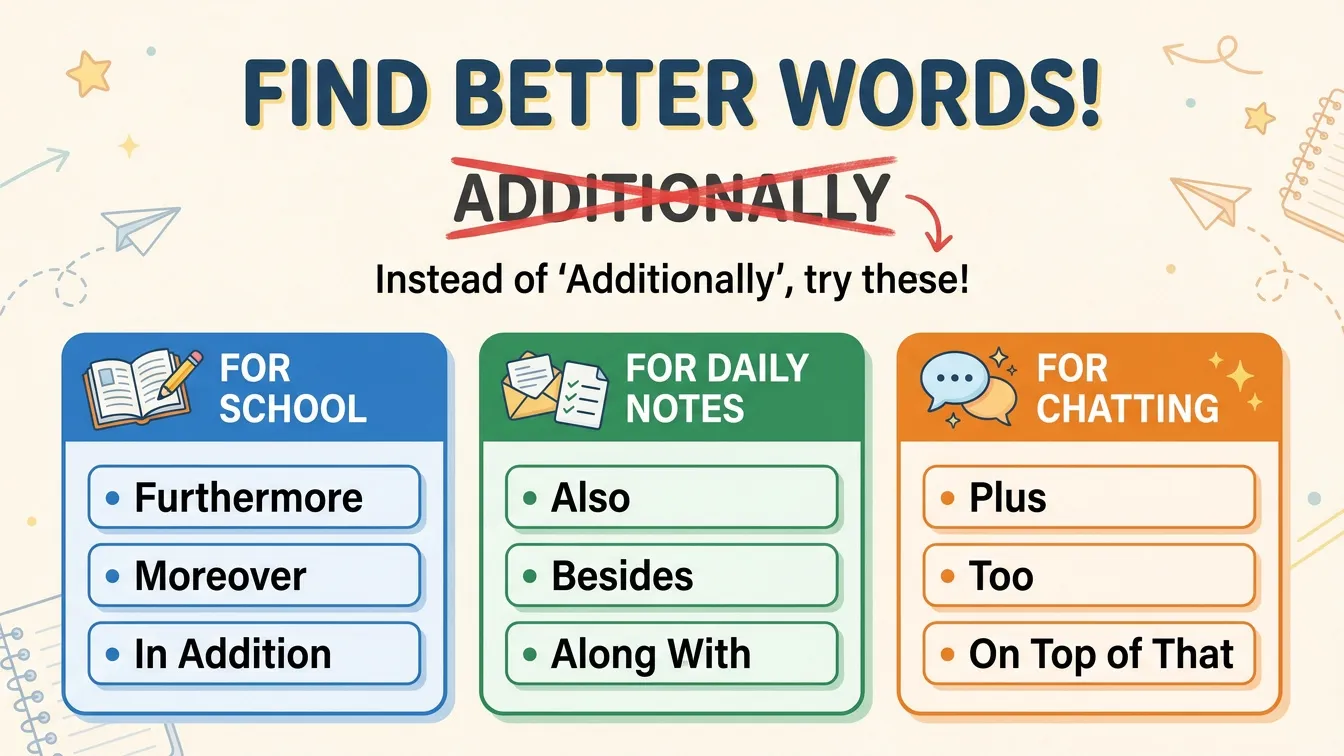
| Where You Are Writing | Best Simple Words to Use | Stronger or Longer Phrases |
| School & Reports | Furthermore, moreover, in addition, further | Likewise, similarly, equally important |
| Work & Daily Notes | Also, besides, along with, as well as | Coupled with, another key point, in the same way |
| Chatting with Friends | Plus, too, as well, on top of that | What’s more, to boot, not to mention |
SECTION 1: SYNONYMS FOR ADDITIONALLY (SCHOOL & REPORTS)
These words are great for school essays, science reports, and serious writing.
Category A: Direct Adding Words
- Furthermore: Adds a new fact that supports your first point.
- Example: Reading every day builds your vocabulary. Furthermore, it helps you write better stories.
- Moreover: Adds a point that is even stronger or more important than the first one.
- Example: Staying up late makes you tired; moreover, it makes it hard to focus in class.
- In addition: The best direct swap for “additionally” in school writing.
- Example: In addition to math homework, we have a science project due on Friday.
- Further: A short and formal way to add one more point.
- Example: Further, the principal agreed to add ten extra minutes to recess.
Category B: Matching & Comparing Words
- Likewise: Used when the new fact matches the first fact closely.
- Example: The soccer team won their game on Friday; likewise, the basketball team won on Saturday.
- Correspondingly: Shows that two things change together in the same way.
- Example: The days got warmer in spring; correspondingly, the flowers began to bloom.
- Similarly: Adds an example that works the exact same way as your first point.
- Example: Plants need water to grow. Similarly, pets need fresh water every day.
Category C: Strong Emphasis Phrases
- Not only that: Highlights a second fact that is even more exciting than the first.
- Example: Our class raised money for the animal shelter. Not only that, we donated fifty blankets.
- Equally important: Moves to a new point that matters just as much as the first one.
- Example: Brushing your teeth keeps them clean. Equally important is flossing every night.
SECTION 2: SYNONYMS FOR ADDITIONALLY (WORK & DAILY NOTES)
These words are best for emails, letters, and everyday writing.
- Also: The easiest and most natural replacement word in English.
- Example: I finished my chores. I also cleaned my bedroom.
- Besides: Adds an extra reason to help explain your choice.
- Example: We should not walk to the store right now. Besides, it is starting to rain.
- Along with: Connects two items or actions smoothly in one sentence.
- Example: Along with a new backpack, she got a set of colored pencils.
- As well as: Adds extra details in the middle of a sentence without starting a new one.
- Example: The camp teaches swimming as well as basic first aid.
- Coupled with: Shows two things working together to cause a result.
- Example: Heavy snow, coupled with icy roads, caused the school bus to arrive late.
Example in context: Along with saving time, a good morning checklist also helps you remember your lunchbox.
SECTION 3: SYNONYMS FOR ADDITIONALLY (CHATTING WITH FRIENDS)
These words sound relaxed and natural when you are talking or texting.
- Plus: Short, easy, and great for everyday speech.
- Example: The new library has comfy chairs. Plus, you can check out comic books.
- On top of that: Stacks multiple good or bad things one after another.
- Example: I missed the bus, forgot my umbrella, and on top of that, I dropped my sandwich.
- What’s more: Adds a fun or surprising extra detail.
- Example: The museum is free on Sundays—and what’s more, they give out free stickers.
- Too / As well: Placed at the very end of a sentence to keep things friendly.
- Example: If you are going to the kitchen, please grab an apple for me, too.
- To boot: A fun phrase that means “in addition,” placed at the end of a sentence.
- Example: He is a fast runner and a great team captain to boot.
- Not to mention: Adds an obvious bonus detail.
- Example: Riding my bike to school is great exercise, not to mention it is way faster than walking.
Example in context: This water bottle keeps drinks cold all day—plus, it fits right inside my backpack pocket.
How to Pick the Right Word
Ask yourself who will read your writing first.
- Writing a school report or essay? Use furthermore, moreover, or in addition.
- Writing an email or daily note? Use also, along with, or as well as.
- Talking or texting with a friend? Use plus, on top of that, or too.
Checking who is reading makes picking the right word simple.
Common Mistakes to Avoid
- Do not use “Additionally” at the start of every paragraph: Repeating the same word makes your writing boring to read.
- Do not forget the comma after starting words: Words like Furthermore, Moreover, and In addition need a comma right after them (“Moreover, the test was easy.”).
- Do not use only a comma to join two full sentences: Put a semicolon before the word and a comma after it (“The game is fun; furthermore, it is easy to learn.”).
- Do not stack two adding words together: Never write “And furthermore” or “Also, in addition.” Pick just one word.
- Do not use “Besides” in formal school reports: Teachers prefer moreover or in addition in serious papers.
Antonyms (Opposites of “Additionally”)
When you want to show a difference or take something away instead of adding, use these opposite words:
- However: Shows a different side or an exception.
- Conversely: Shows the exact opposite result.
- Instead: Picks one thing in place of another.
- Excluding / Except: Leaves something out of a group.
- Nevertheless: Moves in a new direction despite what happened first.
Frequently Asked Questions
Does “additionally” only go at the start of a sentence?
No. It usually goes at the start with a comma, but you can also put it in the middle of a sentence (for example: “The game additionally includes two bonus levels.”).
What is a good everyday synonym for “additionally”?
Also, plus, and along with are all great choices for everyday writing.
What is the best formal synonym for “additionally”?
Furthermore, moreover, and in addition work best for school essays and reports.
How can I make my writing sound natural and not like a robot?
Instead of starting every sentence with Moreover or Furthermore, put also in the middle of your sentence.
Are “furthermore” and “moreover” the exact same?
They are very close, but furthermore adds a normal extra fact, while moreover adds a fact that is much stronger or more important.
What is the shortest synonym for “additionally”?
Also, plus, and too are the shortest one-word swaps.
Final Thought
Additionally is a helpful word, but you do not need to use it every time you add a new thought. The best replacement depends on whether you are writing for school, daily tasks, or chatting with friends.
Always think about your reader first. Once you know the right tone, picking the best word becomes easy.

I’m William Parker, an English language enthusiast and content writer with a passion for words and clear communication. I specialize in writing well-researched content about synonyms, vocabulary, grammar, and word meanings. My goal is to help students, writers, and English learners expand their vocabulary and choose the right words with confidence. I believe learning English should be simple, practical, and enjoyable for everyone.