“Light” is one of the most overworked words in the English language. Open any thesaurus and you’ll find hundreds of alternatives but almost none of them tell you when to actually use each one.
That’s the real problem. A word that sounds perfect for “light rain” will sound completely wrong in “light bulb,” and a synonym that works for “light dessert” will fall flat in “light punishment.”
Most synonym lists online just dump 50 to 5,000 words on you with zero context, forcing you to guess-and-check until something sounds right.
This guide is built differently. Every synonym below is grouped by the actual meaning of “light” you’re trying to express, so you can pick the correct word the first time not the fifth.
By the end of this article, you’ll know exactly which synonym to reach for whether you’re writing product copy, poetry, a school essay, or a business email.
Top 10 Synonyms for “Light”
If you just need the best all-purpose alternatives right now, here they are:
- Illumination (formal, noun)
- Glow (soft, warm)
- Radiance (bright, positive)
- Lightweight (for weight)
- Gentle (for touch, mood)
- Faint (for dim light)
- Airy (for space, fabric)
- Mild (for taste, weather)
- Effortless (for tasks)
- Pale (for color)
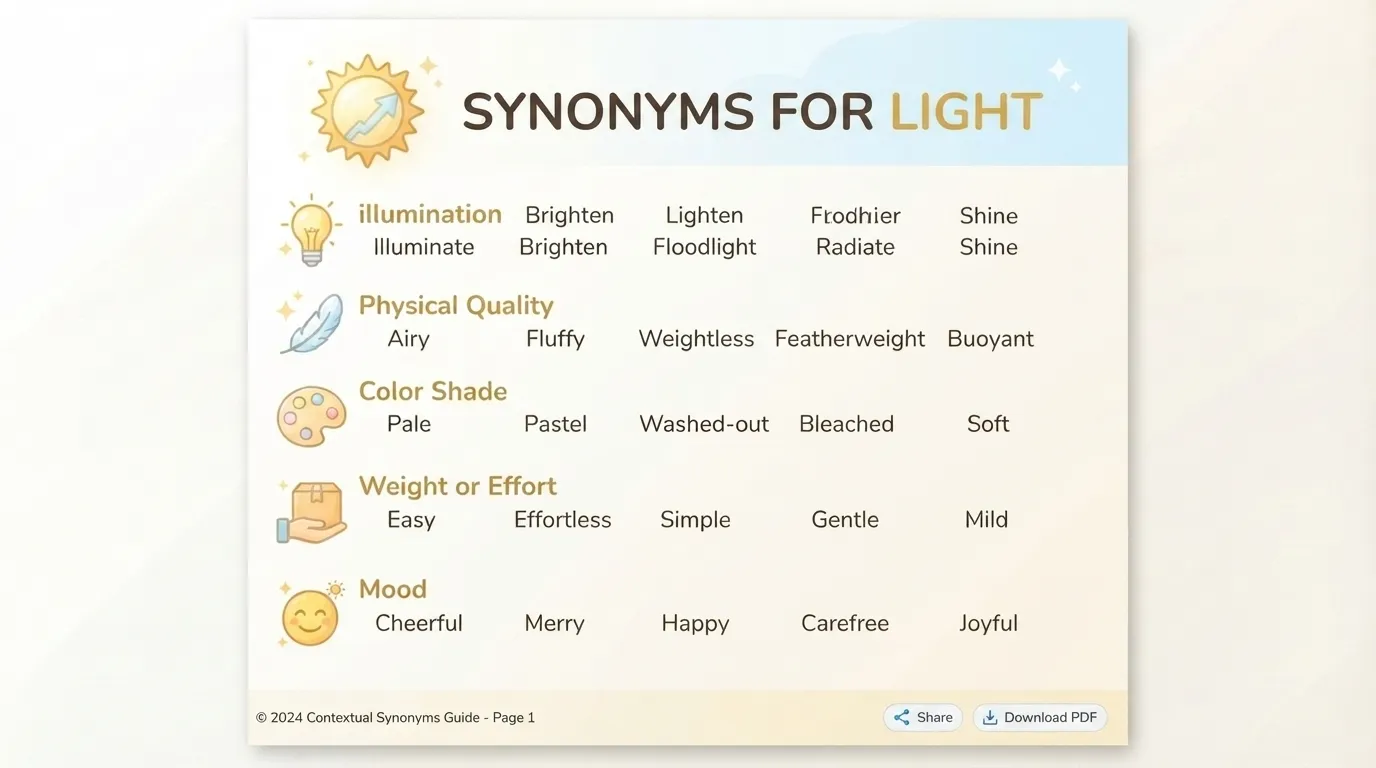
That list will get you through 80% of everyday writing situations. But “light” actually carries six distinct meanings in English, and no single synonym covers all of them. Let’s go through each one properly.
Why “Light” Is So Hard to Replace
Before jumping into the lists, it helps to understand why this word trips up so many writers. Unlike words like “happy” or “fast,” which mean roughly one thing, “light” functions as a noun, adjective, and verb and within each of those roles, it shifts meaning depending on what it’s describing.
- As a noun, it can mean brightness (“turn on the light”) or understanding (“shed light on the problem”).
- As an adjective, it can mean not-heavy (“a light bag”), not-dark (“a light room” or “light blue”), not-serious (“light reading”), or not-strong (“a light breeze”).
- As a verb, it can mean to ignite (“light the candle”) or to land (“the bird lit on the branch”).
This is exactly why a single synonym list fails writers. “Bright” might replace “light” in one sentence and completely change the meaning in the next. So instead of one giant list, here are six categorized lists and pick the one that matches what you’re actually trying to say.
1. Synonyms for Light = Brightness / Illumination
This is the most common meaning people search for the glow that lets you see something.
| Synonym | Best used for |
| Illumination | Formal or technical writing |
| Glow | Soft, ambient light |
| Radiance | Positive, warm brightness |
| Glare | Harsh, intense light |
| Gleam | A brief flash or shine |
| Brilliance | Very strong, dazzling light |
| Luminosity | Scientific/technical contexts |
| Beam | A directed ray of light |
| Sunlight / Daylight | Natural light specifically |
| Flare | Sudden burst of light |
| Shimmer | Light that flickers or wavers |
| Sparkle | Light reflecting off a surface |
| Luster | Light glowing softly off a polished object |
Example: “The candles bathed the ballroom in a soft radiance” reads far better than “the candles bathed the ballroom in soft light.” Notice how “radiance” adds warmth and elegance that plain “light” can’t deliver.
Another example: Instead of “Her eyes had a light in them,” try “Her eyes had a gleam in them” instantly more vivid and specific.
2. Synonyms for Light = Not Heavy (Weight)
This is the meaning most people actually search for when writing product descriptions, reviews, or packing lists.
- Lightweight
- Featherlight / Feather-light
- Weightless
- Airy
- Portable
- Slight
- Buoyant
- Insubstantial
- Delicate
- Thin
- Compact (when weight and size both matter)
- Sleek (for design-focused weight language)
Example: “This is one of the lightest vacuum cleaners on the market” becomes stronger as “This is one of the most featherlight vacuum cleaners on the market.” In marketing copy, “featherlight” and “weightless” tend to convert better than plain “light” because they create a more tactile mental image.
Product-writing tip: Use “lightweight” for technical specs (e.g., “lightweight aluminum frame”) and reserve “featherlight” or “weightless” for emotional, benefit-driven copy (e.g., “so featherlight you’ll forget it’s in your bag”).
3. Synonyms for Light = Pale (Color)
- Pale
- Pastel
- Faded
- Muted
- Washed-out
- Soft-toned
- Fair (for skin/hair specifically)
- Ashen (for a pale, drained tone)
- Blanched
Example: “She wore a light blue dress” → “She wore a pastel blue dress” a small swap that instantly sounds more polished in fashion or lifestyle writing.
4. Synonyms for Light = Easy / Not Serious
This covers phrases like “light work,” “light reading,” and “light punishment” situations where “light” signals something isn’t demanding or heavy in consequence.
- Effortless
- Simple
- Undemanding
- Manageable
- Mild
- Minor
- Trivial
- Casual
- Breezy (for tone/reading)
- Lenient (specifically for punishment or rules)
- Easygoing (for mood or approach)
Example: “He was on the training field for some light work yesterday” → “He was on the training field for some undemanding drills yesterday.”
Example: “She confessed her astonishment at her light sentence” → “She confessed her astonishment at her lenient sentence” “lenient” captures the legal nuance far better than “light” does.
5. Synonyms for Light = Gentle (Touch, Sound, Mood)
- Gentle
- Soft
- Delicate
- Faint
- Subtle
- Mild
- Tender
- Muffled (for sound specifically)
- Whisper-soft
Example: “A light touch on the shoulder” → “A gentle touch on the shoulder” keeps the emotional nuance the word “light” was carrying, while sounding warmer and more intentional.
Example: “A light breeze drifted through the window” → “A faint breeze drifted through the window” works well when you want to emphasize how barely-there the sensation was.
6. Synonyms for Light (Verb) = To Ignite
- Ignite
- Kindle
- Spark
- Set alight
- Torch
- Inflame
- Fire up
Example: “He lit the candle with a match” → “He ignited the candle with a match” for more formal writing, or “He kindled the candle with a match” for a softer, more literary tone.
Bonus verb meaning “to land”: “Light” can also mean to descend and settle, as in “the bird lit on the branch.” Good alternatives here include perch, alight, settle, land, and descend.
What none of them do well: organize synonyms by which of the six meanings of “light” you actually need.
Most sites treat “light” as one word with one big pile of alternatives, which is exactly why so many writers end up picking a synonym that technically appears on a list but doesn’t fit their sentence. That’s the gap this guide fills: pick your meaning above, grab the word, move on.
Which Synonym Should You Actually Use? (Cheat Sheet)
Bookmark this section for quick reference:
- Writing about a lamp or sun → glow, radiance, illumination
- Writing about weight (bags, fabric, devices) → lightweight, featherlight, airy
- Writing about color → pale, pastel, muted
- Writing about a task or workload → effortless, manageable, undemanding
- Writing about touch or tone → gentle, soft, delicate
- Writing about starting a fire → ignite, kindle, spark
- Writing about a bird or object landing → perch, alight, settle
- Writing about punishment or rules → lenient, mild, minor
Common Mistakes When Replacing “Light”
1. Using a brightness synonym for a weight context. “The bag was radiant” doesn’t mean the bag was light in weight, it sounds like the bag was glowing. Stick to lightweight, airy, or featherlight for weight.
2. Overusing “illumination” in casual writing. “Illumination” is a great word but dropping it into a casual blog post or text message will sound stiff. Save it for formal or technical contexts.
3. Confusing “faint” with “dim.” “Faint” describes something barely perceptible (a faint light, a faint sound), while “dim” specifically describes reduced brightness. They overlap but aren’t always interchangeable; “a dim room” works, but “a faint room” doesn’t.
4. Forgetting that “light” can be a verb. Many writers only think of “light” as an adjective and miss opportunities to swap the verb form too “ignite,” “kindle,” and “spark” all add more energy than “light” as a verb.
Frequently Asked Questions
What is the most formal synonym for “light”? Illumination is the most formal choice for brightness; featherweight is the most formal-sounding choice for weight in product/technical writing.
What’s a one-word synonym for “light” that works almost anywhere? It works for touch, sound, mood, and even punishment (“a light/gentle sentence”), making it one of the most flexible substitutes available.
Is “airy” a synonym for light? Yes, specifically for weight and space “an airy room,” “an airy fabric” but not for brightness. Using “airy” to describe a lamp would confuse readers.
What’s the opposite of light? Depending on context: dark (brightness), heavy (weight), deep (color), difficult (task), or harsh (touch/tone).
Which synonym works best for SEO/product titles? For weight-focused products, “lightweight” performs best in search because it’s the term most shoppers actually type. “Featherlight” works well in body copy for emotional appeal but is searched less often.
Using These Synonyms in Different Types of Writing
The right synonym also depends on where you’re writing, not just what you mean. Here’s how to adapt your choice by format:
Marketing and product copy: Favor words that create a physical sensation “featherlight,” “weightless,” “glow.” These words sell an experience, not just a fact.
Academic or technical writing: Stick to precise, formal terms “illumination,” “luminosity,” “lenient” (for legal contexts) since vague or poetic words can weaken credibility.
Fiction and poetry: This is where you can lean into the more evocative options “gleam,” “shimmer,” “kindle,” “alight.” These words carry a mood and rhythm that plain “light” can’t match.
Everyday emails and casual writing: Simpler substitutes work best “gentle,” “easy,” “soft,” “mild.” Overly formal words like “illumination” will feel out of place in a quick message.
Final Thoughts
“Light” is a word that quietly does six different jobs, and that’s exactly why a single synonym list will never serve every writer well.
The next time you reach for a replacement, don’t just grab the first word on a thesaurus page and ask yourself which of the six meanings above you actually need.
Brightness, weight, color, ease, gentleness, or ignition each point to a completely different set of words, and choosing correctly is what separates writing that sounds natural from writing that sounds like it came out of a thesaurus.

I’m William Parker, an English language enthusiast and content writer with a passion for words and clear communication. I specialize in writing well-researched content about synonyms, vocabulary, grammar, and word meanings. My goal is to help students, writers, and English learners expand their vocabulary and choose the right words with confidence. I believe learning English should be simple, practical, and enjoyable for everyone.