“Hate” is one of the most overworked words in English. People use it for cold coffee, for slow Wi-Fi, for a rude email, and for feelings that run deep and last for years. Same word, wildly different weight. When a writer reaches for “hate” every time, the reader loses the ability to tell a passing irritation from real hostility.
Finding another word for hate isn’t a vocabulary game. It is a matter of accuracy: how strong is the feeling, who is feeling it, and who is reading? Dislike, detest, and abhor are not three costumes for the same idea. They sit at different points on a scale, and they carry different tones.
This guide sorts the alternatives by intensity, register, and part of speech, and it separates genuine synonyms from words that only sit near “hate” in a thesaurus.
About this guide. Definitions and usage notes were cross-checked against Merriam-Webster, Longman, Oxford Learner’s Dictionaries, Dictionary.com, Collins, and Etymonline. Words that overlap with “hate” only in certain senses are placed in separate “related” sections instead of being presented as direct swaps. This is a vocabulary guide, so every example sentence is about ordinary things (traffic, lying, cold coffee), never about any group of people. Slang moves quickly, so treat the informal entries as a snapshot.
Quick-Reference Guide: The Intensity Spectrum
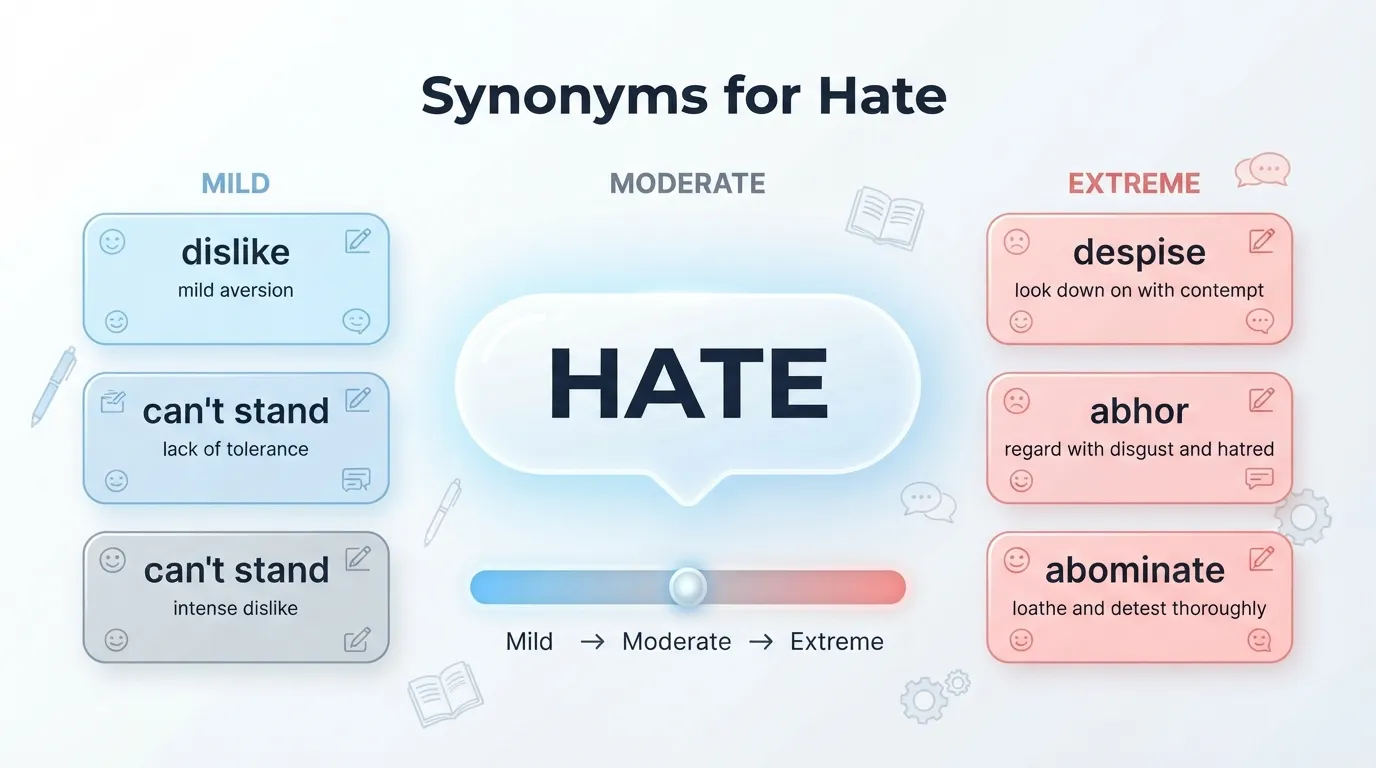
Before choosing a word, place the feeling on the scale:
[ MILD ] ───────────► [ MODERATE ] ───────────► [ EXTREME ]
dislike can’t stand loathe
not care for hate abhor
object to detest abominate
despise
| Context | Best words | Ideal for |
| Professional | dislike, object to, disapprove of | Emails, reports, reviews |
| Everyday speech | can’t stand, can’t bear, not a fan of | Conversation, blogs |
| Emotional or literary | loathe, despise, detest | Fiction, opinion writing |
| Formal or moral | abhor, abominate | Speeches, essays, editorials |
| Noun (the feeling) | hatred, animosity, hostility, loathing | Any register, depending on the word |
1. What “Hate” Is Actually Doing in Your Sentence
Three separate jobs hide inside this one word, and each needs a different replacement:
- A strong feeling (verb): “He hates being lied to.” Use detest, loathe, or despise.
- The feeling itself (noun): “Her voice was full of hate.” Use hatred, animosity, hostility, or loathing.
- Mild irritation or reluctance: “I hate to interrupt,” or “I hate it when the Wi-Fi drops.” Here the honest replacements are dislike, can’t stand, or I’m sorry to, not abhor.
Mixing these up is the most common error. “I abhor to interrupt” is absurd because abhor belongs to the first job, not the third.
2. Milder Alternatives: When You Mean “Hate or Dislike”
Much of the time “hate” is an exaggeration, and a softer word is both more accurate and more professional.
Dislike Meaning: To find something unpleasant or unappealing. Tone: Neutral and mild. Best used in: Professional writing and everyday speech. Example: “Many people dislike open-plan offices.”
Can’t stand / can’t bear Meaning: To find something intolerable, without necessarily hating it. Tone: Emphatic but informal. Longman notes these are less formal than hate and very common in everyday English. Best used in: Conversation and casual writing. Example: “I can’t stand loud chewing.”
Not care for Meaning: To mildly dislike. Tone: Polite and understated. Example: “I don’t much care for cilantro.”
Object to Meaning: To disagree with or oppose on principle. Tone: Formal. Best used in: Meetings, contracts, official responses. Example: “The committee objected to the late change.”
Be sick of / have had enough of Meaning: To be tired of something, out of exhaustion rather than hatred. Tone: Informal. Example: “I’m sick of the same meeting every Monday.”
In professional writing, object to and disapprove of usually read better than anything from the strong end of the scale.
3. Strong and “Fancy” Synonyms for Hate (Verbs)
When you truly mean intense hatred and want something more elevated than “hate,” these are the standard choices.
Detest Meaning: To dislike intensely and durably. Tone: Strong, and a little more formal and deliberate than hate. Example: “I detest being kept waiting.”
Loathe Meaning: To feel utter disgust and intolerance. Tone: Visceral and personal. Example: “She loathes the smell of wet dog.”
Despise Meaning: To hate while looking down on something or someone. Longman describes it as hating with a lack of respect. Tone: Contemptuous. Example: “They despise anyone who takes credit for others’ work.”
Abhor Meaning: To feel deep repugnance, often because something seems morally wrong. Tone: Formal, with moral weight. Example: “He abhors dishonesty in public office.”
Abominate Meaning: To detest strongly, usually with moral condemnation. Tone: Very formal and rare. Example: “Reviewers abominated the film’s cruelty.”
A practical warning: the rarer the word, the more attention it draws. Abominate or execrate in a casual blog post reads as showing off. If the reader has to look it up, it is the wrong word for that audience.
4. Nuance Check: Detest vs. Loathe vs. Despise vs. Abhor
Writers often treat these four as identical. Dictionaries draw finer lines. Merriam-Webster’s synonym notes describe hate as implying an emotional aversion, often with enmity or malice, and separate the others by flavor.
┌────────────┬──────────────────────────────┬───────────────────────────────┐
│ Word │ Core focus │ Emotional flavor │
├────────────┼──────────────────────────────┼───────────────────────────────┤
Detest │ Sustained antipathy │ Firm, deliberate │
Loathe │ Disgust and intolerance │ Visceral, personal │
Despise │ Contempt (looking down on) │ Cold, dismissive │
Abhor │ Moral repugnance │ Formal, principled │
Abominate │ Condemnation │ Rare, very formal │
└────────────┴──────────────────────────────┴───────────────────────────────┘
Choose loathe for disgust, despise for contempt, abhor for moral objection, and detest for firm, settled dislike.
5. Synonyms for Hate as a Noun
When “hate” is the feeling itself, the noun alternatives fall into rough tiers:
| Strength | Words |
| Strongest | animosity, enmity, hostility, loathing, rancor, venom |
| Strong | abhorrence, animus, antipathy, aversion, detestation, malevolence, odium, repugnance, revulsion, scorn, spite |
| Milder | ill will, distaste, no love lost |
A few distinctions worth keeping:
- Hatred is the everyday noun form. Etymonline notes it was formed in the early 13th century by adding the suffix -red to hate.
- Animosity and enmity describe hostility between people or groups.
- Antipathy and aversion are cooler and more formal; they describe a settled dislike more than a burning feeling.
- Rancor and spite carry bitterness and a wish to hurt.
- Ill will is mild and usually about intent (“I bear him no ill will”).
Example: “There was open hostility between the two departments.”
6. Words for a Hateful Person, a Hater, and Hate-Filled Language
Hateful is trickier than it looks, because dictionaries record it pointing in two directions:
- Deserving hate: arousing hatred. Words: loathsome, repugnant, abhorrent, execrable, abominable.
- Full of hate: showing or expressing hatred. Words: malevolent, malignant, spiteful, venomous.
That matters for the phrase “a hateful person.” It might mean someone horrible to be around, or someone consumed by hatred, and readers won’t know which unless you make it clear.
- Person full of hate: spiteful, malicious, malevolent, bitter, vindictive.
- Person or thing that is very unpleasant: odious, obnoxious, loathsome, detestable.
Dictionary.com’s usage note separates hateful (causing extreme dislike), obnoxious (annoying through objectionable qualities), odious (disagreeable), and offensive (displeasing or insulting). Those shades are worth keeping apart.
For hate-filled words or writing, alternatives include venomous, malevolent, vicious, or simply full of hatred.
Hater has two meanings. Neutrally, it is someone who hates something specific (“a hater of opera”). Informally, it is someone who habitually criticizes or belittles others, often unfairly (“ignore the haters”). Context tells you which is meant.
7. Slang and Informal Words
Informal English has its own “hate” vocabulary, and not all of it means actual hatred:
- Hater: informal; someone who habitually belittles or criticizes.
- Hate on: slang; to criticize, dislike, or be jealous of someone or something. “Everyone’s hating on the new logo.”
- The ick: slang; a sudden feeling of disgust or repulsion, most often about a romantic prospect, triggered by some small trait or behavior.
- Hate (noun, internet slang): negative or abusive feedback. “The post got a lot of hate.”
These fit captions, dialogue, and casual blogs. They don’t belong in formal writing.
8. “I Hate You” Synonyms: What to Say Instead
For fiction dialogue, or a moment where the plain word feels too blunt, here is a ladder of alternatives.
Sharper or more literary
- “I despise you.” Hatred with contempt.
- “I loathe you.” Hatred with disgust.
- “I can’t bear the sight of you.” Physical and visceral.
Everyday and emphatic
- “I can’t stand you.” Common and strong, but less formal than “hate.”
Softer or more constructive (often more useful in real life)
- “I’m furious with you.” Names the anger instead of the hatred.
- “I resent what you did.” Points at a specific grievance.
- “I don’t like how you treated me.” Keeps the conversation open.
In real conversations, naming the specific problem usually accomplishes more than reaching for the biggest word available.
9. Idioms and Phrases: Hate vs. Anger
Many idiom lists mix “hate” idioms with idioms about anger and annoyance. They describe different feelings, so it helps to separate them.
About dislike or hatred
- To hate someone’s guts: to dislike someone intensely. “She hates his guts after the way he treated the team.”
- To have it in for someone: to be hostile toward someone over a perceived wrong. “The manager seems to have it in for the new hire.”
- No love lost: mutual dislike. “There’s no love lost between the two rivals.”
- A bête noire / a bugbear: something a person especially dislikes or dreads. Bête noire is the more literary of the two.
- A love-hate relationship: mixed feelings. “I have a love-hate relationship with Monday meetings.”
About annoyance or anger (not really “hate”)
- To drive someone up the wall: to irritate greatly.
- To get on someone’s nerves: to annoy repeatedly.
- To rub someone the wrong way: to irritate without meaning to.
- To see red: to become suddenly, intensely angry.
Match the intensity of the idiom to the situation. “I hate his guts” for a small inconvenience overstates it. “He gets on my nerves” for a deep, lasting grievance understates it.
10. Related Words That Are Not True Synonyms
Some words sit near “hate” but mean something different. Swapping them in changes your meaning:
- Resent: anger or bitterness about unfair treatment. You can resent someone without hating them.
- Disdain / scorn: looking down on something; contempt more than hatred.
- Revile: to criticize abusively and openly; it is about speech, not just feeling.
- Disapprove: a measured judgment, no hostility required.
- Envy / jealousy: wanting what someone else has, a different emotion entirely.
11. Regional Differences: Pet Hate vs. Pet Peeve
Oxford Learner’s Dictionaries lists pet hate as the British English form and pet peeve as the especially North American one. Both mean something you particularly dislike, and both are milder than actual hatred: a personal irritation rather than a burning feeling.
| Expression | Where you’ll hear it | Meaning |
| Pet hate | Mainly British | A specific thing you particularly dislike |
| Pet peeve | Mainly North American | The same idea |
| Bugbear | Common in British usage | A recurring source of irritation |
“My pet hate is people who don’t switch the lights off when they leave a room.”
12. Synonyms for Hate by Starting Letter
Because people search this way, here is a quick lookup. It combines direct synonyms and close related words, so check the notes above before using any of them in sensitive writing.
| Letter | Words |
| A | abhor, abhorrence, abominate, animosity, animus, antagonism, antipathy, aversion |
| D | despise, detest, detestation, disdain, disgust, dislike |
| E | enmity, execrate |
| H | hatred, hostility, horror |
| I | ill will (this letter has few genuine options) |
| L | loathe, loathing |
| M | malevolence, malice |
| O | object to, odium |
| R | rancor, recoil from, repugnance, repulsion, revulsion |
| S | scorn, shudder at, shun, spite, spurn |
| V | venom |
If you need something starting with I and ill will doesn’t fit, you probably want a different concept; indignation, for instance, is closer to anger than to hatred.
13. Antonyms of Hate
The opposite depends on the job the word is doing:
[ HATE ] ◄────────────────────────────────────────► [ LOVE ]
verb: to hate love, adore, admire, cherish, like
noun: hatred affection, fondness, goodwill, kindness
adjective: hateful likable, agreeable, praiseworthy
| Job | Antonyms |
| Verb (to hate) | love, like, adore, admire, cherish, approve |
| Noun (hatred) | love, liking, fondness, friendship, goodwill, kindness, sympathy |
| Adjective (hateful) | likable, agreeable, commendable, praiseworthy |
Pair antonyms by intensity. The opposite of dislike is like or enjoy; the opposite of detest is adore. A mismatched pair sounds forced.
14. Hate Crime and Hate Speech: Fixed Terms
These two phrases come up in searches, but they behave differently from ordinary synonyms.
- Hate crime is also called a bias crime or bias-motivated crime. The FBI describes it as a traditional offense, such as vandalism or assault, carrying an added element of bias. These are legal terms with specific meanings, so use the wording that matches your jurisdiction and context.
- Hate speech is a fixed phrase without a clean one-word synonym. If you need to describe the content itself, describe what it does (for example, “abusive language” or “incitement”) rather than swapping in a single word.
Etymonline dates the phrases in modern use: hate mail to 1951, hate crime to 1988, and hate speech to 1990.
15. Word Forms, Grammar, and Pronunciation
Forms: hate, hates, hated, hating, hater, haters, hateful, hatefully, hatefulness, hatred.
Grammar note: Longman advises that “hate” is normally not used in continuous form (“I am hating that record” isn’t standard), though spoken English sometimes allows things like “I’m hating every minute of this.”
Pronunciation: /heɪt/ in both British and American English. It sounds the same as the surname Haight.
16. Where “Hate” Comes From
Etymonline traces the verb to Old English hatian, from Proto-Germanic haton, and ultimately from a Proto-Indo-European root meaning “sorrow, hatred.” Cognates include German hassen and Dutch haten.
The Greek root miso- (“hatred”) gave English misanthrope, recorded by the 1560s. Modern compounds like hate mail and hate crime are far more recent.
There is a neat symmetry with the word for the opposite feeling. Etymonline notes that friend comes from a Germanic verb form meaning “loving,” while fiend (originally “enemy”) comes from one meaning “hating.” The two words were often paired in Old English, though they are not directly related.
William Parker’s 3 Rules for Choosing the Right Word
- Rule of Intensity. Where does the feeling sit on the scale? Dislike for annoyance, detest for firm aversion, loathe or abhor only for genuinely intense feeling. Overstating the feeling costs you credibility.
- Rule of Register. Who is reading, and where? In a workplace email, object to beats despise every time. In fiction, despise can be exactly right.
- Rule of Target. Are you describing feelings about a thing, a behavior, or a person? “I loathe cold coffee” is harmless. Words aimed at people carry a heavier weight, so choose them with more care.
Frequently Asked Questions
What are some synonyms for hate? Common verb synonyms are detest, loathe, despise, abhor, and can’t stand. Common noun synonyms are hatred, animosity, hostility, and loathing.
What are strong synonyms for hate? Loathe, despise, abhor, and detest. Abominate is stronger and more formal, but rare.
What is a less strong word than hate? Dislike is the standard milder choice. Can’t stand, not care for, and object to are useful in everyday and professional writing.
What’s a fancy word for hate? Abhor, detest, or abominate, depending on how formal you need to be. Use rare words sparingly.
What’s the difference between hate and dislike? Dislike is a mild, neutral judgment. Hate is stronger and often implies hostility or intense aversion.
What is a synonym for a hateful person? It depends on the meaning. For someone consumed by hatred: spiteful, malicious, malevolent. For someone unpleasant to deal with: odious, obnoxious, detestable.
What is another word for a hater? Neutrally, a person who hates something specific. Informally, critic, naysayer, or detractor, depending on tone.
What are antonyms of hate? Love, like, adore, admire, and (as nouns) affection, fondness, and goodwill.
What are synonyms for hate speech and hate crime? Hate crime is also called a bias crime or bias-motivated crime. Hate speech is a fixed phrase without a clean one-word synonym.
Final Thoughts
“Hate” is a small word carrying a great deal of weight, and part of using it well is knowing when it is too much. Most everyday uses don’t call for hatred at all; they call for dislike, can’t stand, or object to.
The stronger words earn their place only when the feeling is genuinely intense, and each carries its own flavor: disgust in loathe, contempt in despise, moral revulsion in abhor.
The quickest test is to say the sentence aloud with the replacement in it. If the word sounds bigger than the situation, step down a rung. If it sounds smaller, step up. Once the word matches the feeling, the right choice is usually obvious.

I’m William Parker, an English language enthusiast and content writer with a passion for words and clear communication. I specialize in writing well-researched content about synonyms, vocabulary, grammar, and word meanings. My goal is to help students, writers, and English learners expand their vocabulary and choose the right words with confidence. I believe learning English should be simple, practical, and enjoyable for everyone.