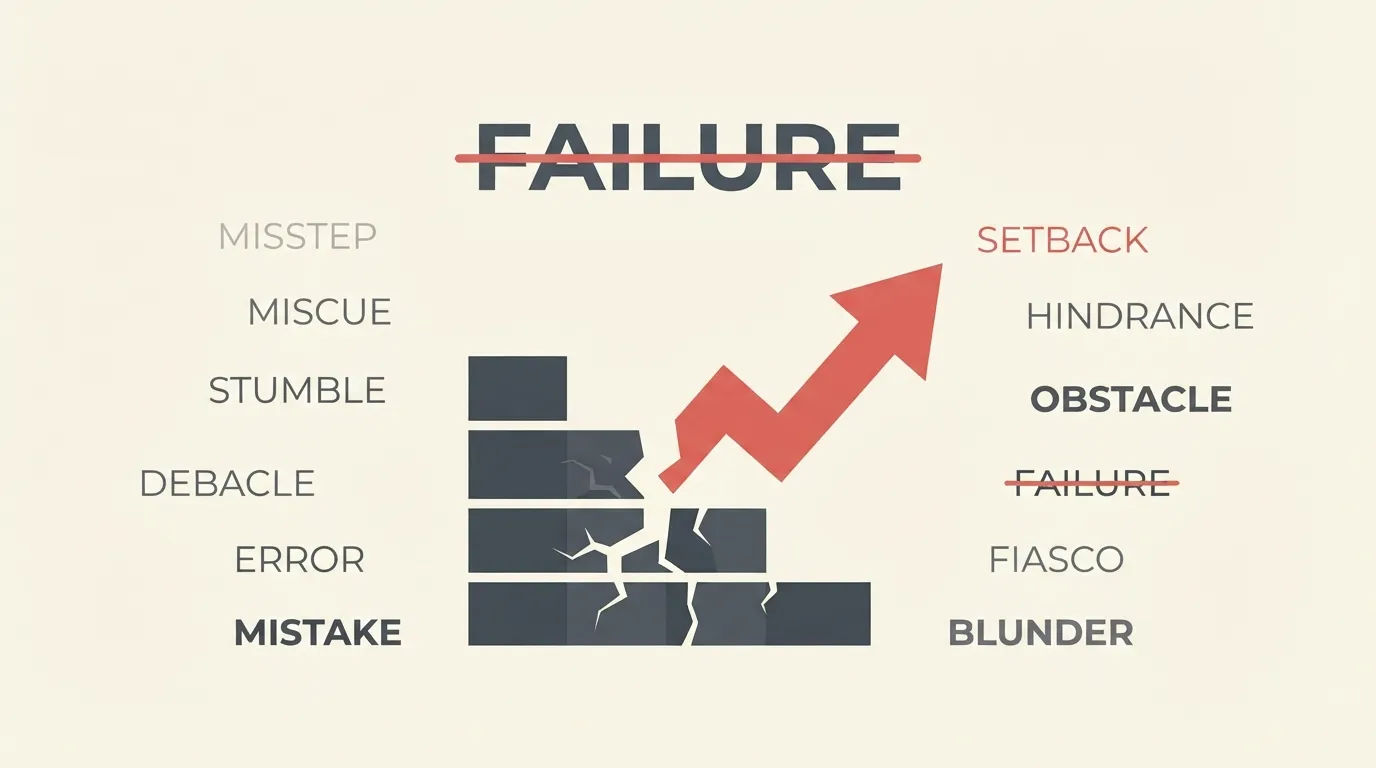
“Failure” is one of the bluntest words in English, and most writers reach for it by default even when it doesn’t fit. Calling a missed deadline a “failure” overstates it; calling a company’s collapse a “failure” understates it.
This guide sorts the real alternatives by severity and context: corporate, creative, academic, and casual and separates true synonyms from words that only sound like they mean the same thing.
Editors run into this constantly. A performance review that calls a single missed target a “failure” reads as needlessly harsh. A crisis report that calls a total system collapse a “shortcoming” reads as evasive, maybe even dishonest.
The word itself isn’t wrong in either case it’s just imprecise. English has better tools for both ends of that spectrum, and most synonym lists don’t sort them properly. They dump formal, informal, mild, and severe words into one undifferentiated pile and let the reader guess.
This guide doesn’t do that. Every word below is placed by tone, intensity, and register cross-checked against standard reference sources (Cambridge, Collins, and Etymonline) rather than assembled from memory so you can find the one that actually matches what happened.
The Failure Spectrum: A Quick-Reference Map
Not all failures carry the same weight. Before reaching for a word, place the event on a rough scale:
[ MINOR ] ──────────► [ MODERATE ] ──────────► [ SEVERE ]
misstep setback debacle
slip-up shortcoming fiasco
oversight misfire catastrophe
| Context | Best Words | Best Used For |
| Workplace / Business | setback, misstep, oversight, shortfall | Reports, emails, client communication |
| Creative / Journalistic | fiasco, debacle, catastrophe, meltdown | Fiction, opinion writing, headlines |
| Academic / Technical | inadequacy, deficiency, malfunction, breakdown | Research papers, audits, systems analysis |
| Casual / Conversational | flop, dud, bust, bomb, damp squib (UK) | Blogs, dialogue, everyday speech |
1. Professional and Corporate Alternatives
In business writing, the word “failure” can read as accusatory or needlessly final. These words let you describe the same event while keeping the tone constructive, useful in status reports, performance reviews, and client-facing communication.
Setback an unexpected reversal or delay, with the implication that recovery is still possible. “The supply chain delay caused a setback, but the launch date is still achievable.”
Misstep a mistake in judgment or process, phrased around the action rather than the person. “The campaign suffered a misstep due to thin market research.”
Oversight an unintentional failure to notice or account for something; soft and non-accusatory. “Due to an administrative oversight, the renewal was delayed by a week.”
Shortcoming a failure to meet a required standard, used in evaluative contexts. “The audit flagged several shortcomings in the onboarding process.”
Shortfall specifically a gap between what was expected and what was delivered, often financial. “Revenue came in below target, leaving a shortfall the board wants addressed.”
None of these are interchangeable. A “setback” implies the goal is still reachable; a “shortcoming” implies a standard wasn’t met and needs correcting, with no promise either way about what comes next. Picking the wrong one can accidentally signal more (or less) optimism than you intend.
2. Creative and Dramatic Synonyms
For fiction, journalism, and commentary, you often want a word that carries weight, spectacle, embarrassment, or ruin, not just a missed target.
Fiasco is a complete, often ridiculous failure, usually witnessed publicly. “The product demo turned into a fiasco when it crashed live on stage.”
Debacle a sudden, chaotic collapse, implying the whole structure gave way, not just one part of it. “The merger ended in a debacle that wiped out half the company’s stock value.”
Catastrophe is an event causing severe, often sudden damage; reserved for genuinely serious situations. “Without emergency funding, the festival faced financial catastrophe.”
Meltdown an abrupt, visible breakdown, often emotional or organizational rather than purely financial. “The press conference turned into a meltdown once the numbers were questioned.”
Nuance Check: Setback vs. Fiasco vs. Debacle
These three get flattened into synonyms constantly, but they’re doing distinct jobs:
| Word | Core focus | Emotional weight |
| Setback | Temporary delay | Low, implies recovery |
| Fiasco | Public embarrassment | High, implies people noticed and reacted |
| Debacle | Structural collapse | Severe, implies the whole system broke |
Use setback if the goal is still reachable. Fiasco if the failure was witnessed and mocked. Use debacle if the entire structure a company, a plan, an institution came apart.
3. Idioms and Phrases for Failure
Sometimes a single word doesn’t capture the texture of a failure how sudden it was, how it felt, who was watching. English has a deep well of idioms for this, and most synonym lists skip them entirely.
- To bite the dust to fail or be defeated, often suddenly. “The airline start-up looked shaky for months before it finally bit the dust.”
- To come a cropper informal (mainly British), to fail badly or suffer a setback. “The team came a cropper after trading away their best player.”
- To go down the tubes / down the drain to fail or be wasted entirely. “Without new funding, the whole project is going down the tubes.”
- To crash and burn a sudden, dramatic failure, often after early promise. “The campaign crashed and burned in its final week.”
- To fall through a plan that collapses before completion. “The acquisition fell through at the last minute.”
- To fall flat an attempt that fails to produce the intended effect, often used for jokes, pitches, or performances. “The opening speech fell flat with the audience.”
- Back to square one a failure that erases progress entirely, forcing a restart. “When the funding fell through, we were back to square one.”
A useful rule with idioms: match the intensity to the actual scale of the failure. Calling a single missed deadline a case of “everything going down the tubes” overstates it; calling a company’s total collapse a matter of the team having “come a cropper” understates it badly. Idioms carry connotation as much as denotation, so treat the intensity as part of the meaning, not just decoration.
4. Business and Startup-Specific Failure Language
Business writing has its own vocabulary for organizational failure, and it’s more precise than general synonym lists usually capture.
Go bust informal; a business runs out of money and can no longer operate. More formal equivalents are “go bankrupt” or “cease trading.” “Dozens of small travel agencies went bust during the long shutdowns.”
Go under used primarily in business contexts, meaning a company becomes bankrupt or ceases to function. “The startup went under after failing to secure a second funding round.”
Fold informal; suggests a business simply stopped operating, often abruptly rather than through a drawn-out decline. “The magazine folded after eleven years.”
Liquidation / insolvency / receivership formal legal and financial terms for different stages of business failure. Liquidation means assets are sold off to pay debts; insolvency means the company can’t meet its financial obligations; receivership means an external party has taken control of the business’s finances.
These aren’t interchangeable with “fiasco” or “debacle” they’re precise, procedural terms, and using them signals that you understand the mechanics of business failure, not just the drama of it.
5. Academic and Everyday Failure Terms
Flunk informal, mainly American English, specifically about failing an exam, course, or test. “He flunked the final and had to retake the class in summer.”
This is a narrow word it applies almost exclusively to academic failure, not business or personal failure. Using “flunk” outside an academic context (“the company flunked its quarterly targets”) reads as a deliberate, slightly jokey register choice rather than a neutral synonym.
6. US vs. UK: Where the Words Split
| Word | Region | Example |
| Flunk | US, academic | “She flunked chemistry twice before passing.” |
| Damp squib | UK | “The protest turned out to be a bit of a damp squib once the rain started.” |
| Go belly up | mainly US informal | “The tech startup went belly-up within six months.” |
| Cockup | UK, informal (can read as crude in some settings) | “The whole rollout was a complete cockup.” |
| Omnishambles | UK informal | “Critics called the rollout an omnishambles from day one.” |
| Bomb | mainly US informal | “The play absolutely bombed on opening night.” |
| Flop, dud, bust | common in both US and UK English | “Her third novel was a commercial flop.” |
Note that “cockup” carries a coarser register in British English than its American near-equivalent “screwup” fine for casual writing, worth avoiding in anything formal.
7. Technical and Systemic Failure Words
These describe failure in systems, machines, or processes rather than people or plans they’re related terms, not general-purpose stand-ins for “failure.”
Breakdown a cessation of normal function, used for both machines and processes. “A breakdown in communication led to missed deadlines across departments.”
Malfunction a failure to operate correctly, almost always about equipment or software rather than people or plans. “The software malfunction caused an unintended data leak.”
Inadequacy a state of not meeting a required standard, common in audits and formal evaluation. “The review exposed inadequacies in the company’s security protocols.”
8. Related (Not Synonymous) Words Worth Knowing
Some words often appear near “failure” in writing but don’t mean the same thing, and listing them as direct synonyms would be inaccurate.
Lapse a temporary failure of concentration, memory, or judgment. It describes a brief slip, not a sustained failure. “In a lapse of judgment, the officer shared details he shouldn’t have.”
Deficit a shortfall or shortage, usually financial. It describes an amount that’s missing, not an event that failed. “The department is running a staffing deficit that’s slowing delivery.”
Delinquency specifically about falling behind on an obligation, usually financial or legal (as in “mortgage delinquency”). It’s not a general synonym for failure outside that narrow use.
Treating these as loose synonyms for “failure” is where a lot of thesaurus content goes wrong they’re related concepts that show up in similar sentences, not words you can swap in freely.
9. Antonyms of Failure
| Word | Opposite |
| failure | success, achievement |
| setback | progress, advancement |
| deficiency | sufficiency, adequacy |
| debacle | triumph |
| shortcoming | strength |
Note that “setback” and “breakthrough” are often paired as opposites in casual writing, but they’re not a clean match a breakthrough is a positive event in its own right, not simply the absence of a setback. “Progress” or “advancement” is the more accurate opposite.
10. Formal vs. Casual: Matching Tone
| Formal | Neutral | Casual |
| deficiency, inadequacy, nonperformance | failure, setback, shortcoming | flop, dud, bust, bomb |
| debacle (in journalism/formal writing) | misstep, oversight | damp squib, cockup, flunk |
If you’re writing a board memo, “shortfall” or “underperformance” earns its place. If you’re writing dialogue for a frustrated character, “total bust” or “complete dud” will sound far more natural.
Etymology, Briefly
“Failure” has a more interesting history than most vocabulary guides mention. It traces back to Latin fallere, meaning “to deceive” or “to trip someone up” the same root behind “false” and “fallacy.” The word moved through Old French falir into Anglo-French failer, and the English noun “failure” didn’t appear until the 1640s, formed by adding the suffix -ure (as in “measure” or “pleasure”) to the existing verb “fail.” Before that, the noun form was simply “fail,” a usage that survives today only in the phrase “without fail.”
What’s notable is the shift in meaning along the way: the original Latin sense was closer to being deceived by circumstances than to personally falling short. The word gradually came to mean individual shortcoming only as it passed through French and into English a reminder that “failure” wasn’t always about blame.
The Method: Three Questions Before You Choose a Word
- What’s the scale? A missed typo isn’t a catastrophe. A total system collapse isn’t a shortcoming. Match the word’s weight to the actual damage.
- Who’s the audience? Business readers respond to clear, solution-oriented words like setback or shortfall. Casual or creative writing can carry heavier, more vivid words like debacle or fiasco without sounding evasive.
- Is recovery implied? Words like setback and misstep suggest the situation is still fixable. Words like collapse and debacle suggest it isn’t. Choosing between them quietly signals how serious you think the situation is so choose on purpose.
Frequently Asked Questions
What’s the most polite word for failure in a business setting? Setback, shortfall, and oversight are the most common diplomatic choices; they describe what happened without assigning blame or implying the situation is unrecoverable.
What’s the difference between a flop and a dud? A flop usually describes a high-profile creative or commercial venture: a film, an album, a product launch that failed to perform. A dud more often describes something that fails to work or generate any excitement at all, and can apply to smaller things (a dud firework, a dud idea) as easily as large ones.
Is “fiasco” stronger than “failure”? Yes. “Failure” is neutral; it just means a goal wasn’t met. “Fiasco” adds the sense that the failure was public, embarrassing, and often somewhat absurd.
What’s a good academic or formal word for failure? Inadequacy, deficiency, and nonperformance are the standard formal choices, common in audits, research papers, and legal writing.
Conclusion
“Failure” isn’t a wrong word, but it’s a blunt one and blunt words flatten situations that usually deserve more precision. A missed deadline, a canceled merger, and a bankrupt company are not the same event, even though a lazy first draft might call all three “failures.”
The difference between setback, fiasco, and debacle isn’t just style; it’s information. It tells the reader how serious the situation actually was, and whether recovery is still on the table.
The fastest way to choose well is to stop treating this as a vocabulary problem and start treating it as a calibration problem: how big was it, who’s reading, and is it fixable? Answer those three questions, and the right word usually finds itself.

I’m William Parker, an English language enthusiast and content writer with a passion for words and clear communication. I specialize in writing well-researched content about synonyms, vocabulary, grammar, and word meanings. My goal is to help students, writers, and English learners expand their vocabulary and choose the right words with confidence. I believe learning English should be simple, practical, and enjoyable for everyone.