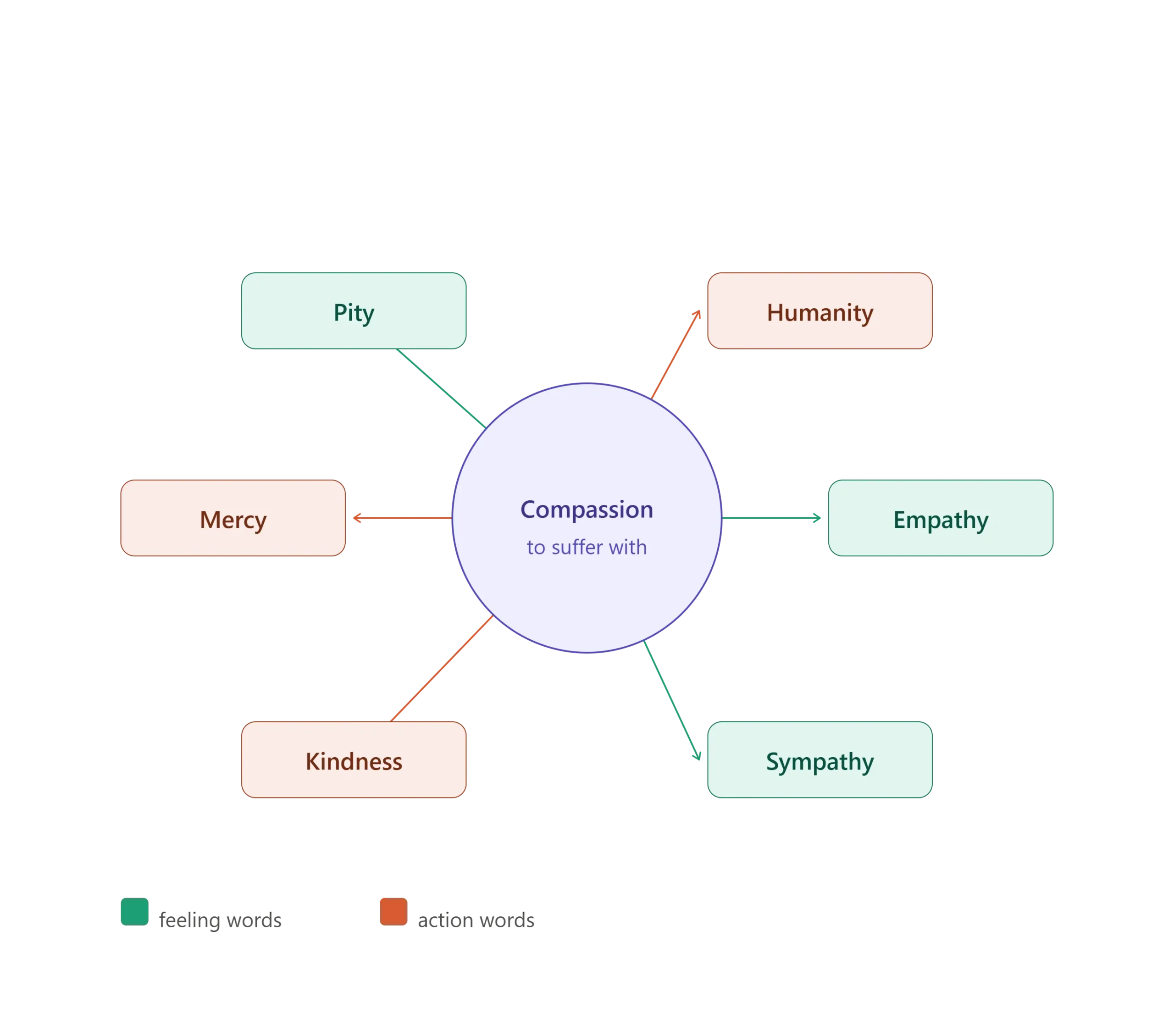
Compassion means recognizing another person’s suffering and feeling moved to help or ease it. But not every word connected to compassion means exactly the same thing.
For example, empathy focuses on understanding or sharing another person’s feelings, while sympathy expresses concern for someone else’s situation. Mercy often involves choosing to forgive or spare someone, while pity can sometimes create emotional distance.
That difference matters when you’re writing an essay, condolence message, resume, performance review, or everyday conversation.
In this guide, you’ll find 60+ synonyms and closely related words for compassion, along with simple meanings, examples, and tips for choosing the right word.
Quick Answer: What Is the Best Synonym for Compassion?
The closest everyday alternatives to compassion include sympathy, empathy, kindness, mercy, pity, commiseration, humanity, humaneness, and kindheartedness.
However, the best word depends on what you want to emphasize:
| Word | Best when you want to express… |
| Empathy | Understanding or sharing another person’s feelings |
| Sympathy | Concern for someone’s difficulty or suffering |
| Kindness | Caring behavior or helpful action |
| Mercy | Forgiveness, leniency, or choosing not to punish |
| Pity | Sorrow for someone’s suffering, sometimes with distance |
| Commiseration | Expressed sympathy for someone’s hardship |
| Humanity | Kindness and concern for other people |
| Benevolence | A generous desire to do good |
| Humaneness | Treating others with dignity and kindness |
| Kindheartedness | A naturally caring and gentle nature |
If you need a safe everyday alternative, kindness or sympathy often works well. If you want to emphasize understanding another person’s feelings, empathy may be more appropriate.
What Does Compassion Mean?
Compassion is a noun describing concern for another person’s suffering, together with a desire to help or relieve it.
Merriam-Webster defines compassion as sympathetic awareness of another person’s distress along with a desire to alleviate it. It also distinguishes compassion from empathy by noting that compassion adds a desire to reduce the person’s distress.
In simple terms, compassion has three important ideas:
- You notice that someone is suffering.
- You care about what they are experiencing.
- You feel motivated to help.
Stanford’s Center for Compassion and Altruism Research and Education similarly describes compassion in terms of recognizing suffering, feeling concern, and wanting to alleviate it. Its research materials also include willingness to respond or take action as part of compassion.
Example:
The teacher showed compassion by giving the struggling student extra time.
Closest Synonyms for Compassion
These are the words most likely to overlap with compassion in everyday writing. Still, each one has its own shade of meaning.
Empathy
Empathy means understanding or sharing another person’s feelings or emotional experience. It is especially useful when you want to emphasize emotional understanding rather than the desire to help.
Example:
Her empathy helped her understand why the new employee felt nervous.
Sympathy
Sympathy means feeling concern for someone who is experiencing pain, loss, or difficulty. It can express care without suggesting that you personally share the person’s feelings.
Example:
We sent our sympathy to the family after their loss.
Kindness
Kindness describes friendly, caring, or helpful behavior toward another person. It overlaps with compassion when concern is expressed through an action.
Example:
His kindness made the frightened child feel safe.
Mercy
Mercy involves showing compassion by forgiving, sparing, or reducing punishment or suffering. It is especially appropriate when one person has power or authority over another.
Example:
The judge showed mercy and reduced the man’s sentence.
Pity
Pity means feeling sorrow for someone’s suffering or misfortune. It can overlap with compassion, but in some contexts it may sound distant or slightly condescending.
Example:
She felt pity for the injured bird and called a wildlife rescue center.
Commiseration
Commiseration means expressing sympathy with someone who is experiencing difficulty, disappointment, or loss. It is more formal than everyday words such as sympathy.
Example:
His friends offered words of commiseration after he lost his job.
Humanity
Humanity can refer to kindness, compassion, and concern for other people. It works particularly well when discussing moral behavior or treatment of vulnerable people.
Example:
The volunteers showed great humanity during the disaster.
Humaneness
Humaneness describes a quality of being kind, compassionate, and considerate toward others.
Example:
The shelter is known for its humaneness toward abandoned animals.
Kindheartedness
Kindheartedness describes a naturally caring and generous character. It is often used to describe someone’s personality.
Example:
Her kindheartedness was obvious when she volunteered every weekend.
Benevolence
Benevolence means a desire to do good or help others. It has a more formal tone and often appears in professional, academic, or charitable writing.
Example:
The foundation was established through the benevolence of several donors.
Generosity
Generosity involves giving freely, whether through money, time, attention, or support. It can be an expression of compassion, although the two words are not identical.
Example:
His generosity helped the family pay their medical bills.
Sensitivity
Sensitivity means being aware of other people’s feelings, needs, or difficulties. It is useful when describing someone who responds thoughtfully to emotional situations.
Example:
She handled the grieving employee’s situation with sensitivity.
Understanding
Understanding can describe awareness and acceptance of another person’s situation or feelings. It works especially well in relationships and workplace contexts.
Example:
Her understanding helped her friend talk openly about the problem.
Concern
Concern means caring about someone’s well-being or difficulty. It is broader than compassion and does not always imply a desire to take action.
Example:
The manager expressed concern about the employee’s health.
Kindliness
Kindliness refers to a friendly, gentle, and caring attitude toward others. It has a warm but slightly more formal feel than kindness.
Example:
The old man was respected for his patience and kindliness.
Goodwill
Goodwill means a friendly or helpful attitude toward another person or group. It is common in professional, social, and diplomatic contexts.
Example:
The charity project created goodwill throughout the community.
Warmheartedness
Warmheartedness describes a naturally warm, caring, and affectionate personality.
Example:
Her warmheartedness made everyone feel welcome.
Softheartedness
Softheartedness means being easily moved by the suffering or needs of others. It can suggest a gentle emotional nature.
Example:
His softheartedness made it difficult for him to ignore people asking for help.
Bigheartedness
Bigheartedness describes generous, caring, and forgiving behavior. It is informal and works well in personal writing.
Example:
Her bigheartedness was clear when she welcomed the struggling family into her home.
Largeheartedness
Largeheartedness means generosity of spirit, especially toward people who need help or forgiveness. It has a more literary or formal tone.
Example:
His largeheartedness earned him the respect of the entire community.
More Related Words for Compassion
The following words are connected to compassion but should not automatically replace it in every sentence.
Altruism
Altruism means acting for the benefit of others without expecting personal gain. Compassion can motivate altruistic behavior, but the words describe different ideas.
Example:
Her altruism inspired her to spend her weekends helping homeless families.
Charity
Charity can mean generous help given to people in need, especially money, food, or other resources. It is often an action that grows out of compassion.
Example:
The organization provides charity to families affected by poverty.
Philanthropy
Philanthropy refers to generous support for charitable, educational, social, or humanitarian causes. It is usually broader and more formal than compassion.
Example:
His philanthropy has funded several children’s hospitals.
Humanitarianism
Humanitarianism is concern for human welfare and a commitment to reducing suffering. It is often used when discussing large-scale social or international efforts.
Example:
Her work in humanitarianism took her to disaster-affected communities.
Condolence
Condolence refers to an expression of sympathy toward someone who has experienced a death or serious loss. It is more specific than compassion.
Example:
We sent our condolences to the family.
Ruth
Ruth is an older or literary word meaning pity, compassion, or sorrow for another person’s suffering.
Example:
The poem describes a warrior who showed ruth toward his defeated enemy.
Magnanimity
Magnanimity means generosity and nobility of spirit, especially when responding to someone who has wronged you.
Example:
She showed magnanimity by forgiving her former rival.
Affinity
Affinity means a natural liking, connection, or similarity between people. It can support compassionate relationships but is not a direct synonym.
Example:
She felt an immediate affinity with the older people residents.
Rapport
Rapport means a comfortable and trusting relationship between people. Compassion can help build rapport, but the terms are not interchangeable.
Example:
The counselor quickly developed rapport with the young patient.
Benignity
Benignity means a kind, gentle, or favorable disposition. It is uncommon in everyday English but can work in formal or literary writing.
Example:
The leader was remembered for his benignity toward ordinary citizens.
Regard
Regard can mean respect, care, or consideration for another person. It is broader than compassion.
Example:
She treated every member of the team with equal regard.
Affection
Affection means warm feelings of liking, care, or love. It can accompany compassion but does not necessarily involve suffering or a desire to help.
Example:
He spoke about his grandmother with great affection.
Love
Love can include deep care and concern for another person, but it is much broader than compassion.
Example:
Her love for her family motivated her to support them through difficult times.
Responsiveness
Responsiveness means reacting appropriately to another person’s needs or concerns. It can describe compassionate behavior in healthcare, education, or customer service.
Example:
The nurse’s responsiveness helped the patient feel heard.
Good-Heartedness
Good-heartedness describes a naturally kind and caring character.
Example:
His good-heartedness made him the first person people called for help.
Compassion vs. Empathy vs. Sympathy vs. Pity
These four words are often treated as interchangeable, but their meanings can differ.
| Word | Main idea | Emotional distance | Desire to help |
| Compassion | Caring about suffering and wanting to ease it | Close | Strong |
| Empathy | Understanding or sharing another person’s experience | Close | Not always required |
| Sympathy | Feeling concern for someone’s difficulty | Moderate | Possible |
| Pity | Feeling sorrow for someone’s misfortune | More distant | Not always present |
A simple way to remember the distinction is:
Empathy: “I understand what you may be feeling.”
Sympathy: “I care that you’re going through this.”
Compassion: “I care, and I want to help.”
Pity: “I feel sorry that this happened to you.”
Merriam-Webster makes a similar distinction: empathy can involve sharing another person’s emotional experience, while compassion adds a desire to alleviate distress. It also notes that pity can sometimes carry a slightly contemptuous or condescending implication.
Psychological research also shows that the boundaries between empathy and compassion are more nuanced than a simple dictionary-style definition suggests. Researchers use different definitions of empathy, including emotional sharing and perspective-taking.
Synonyms for Compassionate
Sometimes you are not looking for a noun like compassion. You need an adjective to describe a person, action, or approach.
Caring
A caring person pays attention to other people’s needs and wants to support them.
Example:
She is a caring manager who listens to her employees.
Kind
Kind describes someone who treats others with friendliness, generosity, and consideration.
Example:
He was kind enough to stay with his friend during the difficult night.
Empathetic
Empathetic describes someone who is skilled at understanding another person’s feelings or perspective.
Example:
The empathetic counselor listened without judging her.
Sympathetic
Sympathetic means showing concern for someone’s difficulties or feelings.
Example:
The teacher was sympathetic when the student explained what had happened.
Understanding
An understanding person recognizes why someone may be struggling and responds with patience rather than quick judgment.
Example:
Her understanding supervisor gave her time to recover from the stressful week.
Humane
Humane means showing kindness and concern for people’s or animals’ welfare.
Example:
The shelter uses humane methods to care for abandoned animals.
Merciful
Merciful describes someone who chooses forgiveness or avoids causing unnecessary suffering.
Example:
The merciful leader allowed the prisoners to return home.
Benevolent
Benevolent means well-meaning and inclined to help others.
Example:
The benevolent donor funded a new community clinic.
Considerate
Considerate describes someone who thinks about other people’s feelings and needs before acting.
Example:
It was considerate of him to check on his old man neighbor.
Tenderhearted
Tenderhearted means easily moved by the suffering or needs of others.
Example:
Her tenderhearted nature made her passionate about animal rescue.
Warmhearted
Warmhearted describes someone who is friendly, affectionate, and caring.
Example:
The warmhearted volunteer welcomed every new visitor.
Big-Hearted
Big-hearted is an informal way to describe someone who is generous, forgiving, and caring.
Example:
Everyone appreciated the big-hearted coach.
Another Word for Compassionate Care
Compassionate care means providing support with genuine concern, respect, patience, and attention to another person’s needs.
Depending on the context, alternatives include empathetic care, caring support, humane care, patient-centered care, considerate care, and gentle support.
However, these phrases are not always perfect replacements. In healthcare writing, compassionate care may be the clearest choice when you specifically want to emphasize concern for a patient’s suffering.
Example:
The nursing team is committed to providing compassionate care to every patient.
Stanford CCARE also describes compassion as an important and trainable quality in healthcare and offers education focused on compassionate clinical practice.
Synonyms for Compassion in an Essay
When writing an essay, choose a synonym based on the idea you want to emphasize.
For emotional understanding:
- Empathy
- Understanding
- Sensitivity
- Emotional awareness
For kindness:
- Kindness
- Kindheartedness
- Humanity
- Humaneness
Helping others:
- Benevolence
- Generosity
- Altruism
- Goodwill
Formal writing:
- Benevolence
- Humaneness
- Humanity
- Magnanimity
- Humanitarianism
Example:
Instead of writing:
The leader showed compassion toward vulnerable families.
You could write:
The leader showed humanity toward vulnerable families.
Or:
The leader demonstrated benevolence by funding emergency housing.
The best choice depends on whether you want to emphasize emotion, kindness, generosity, forgiveness, or action.
Synonyms for Compassion and Kindness
Compassion and kindness overlap, but they are not identical.
Compassion usually begins with recognizing suffering and feeling concerned about it. Kindness is broader and can describe any thoughtful or helpful behavior, even when nobody is suffering.
For example:
She showed compassion by comforting a grieving friend.
She showed kindness by helping a stranger carry groceries.
Both actions are caring, but only the first directly responds to suffering.
Compassion Synonyms by Context
Compassion in the Workplace
In a workplace, words such as empathy, understanding, consideration, support, patience, and responsiveness can work well.
Example:
The manager showed empathy when an employee explained the challenges affecting her performance.
Compassion in Healthcare
Healthcare writing often uses compassion, empathy, kindness, humaneness, caring, and patient-centered support.
Example:
Patients often value both clinical skill and compassionate care from their healthcare providers.
Compassion in Spirituality
In spiritual or religious writing, related terms may include mercy, loving-kindness, charity, humanity, and benevolence.
Example:
The teaching encourages mercy and compassion toward people who are suffering.
Self-Compassion
When discussing self-compassion, useful related expressions include self-kindness, self-acceptance, self-forgiveness, patience with yourself, and gentleness toward yourself.
Example:
Self-compassion means treating your own mistakes with the same patience you might offer a close friend.
Compassion in a Resume
For a resume, words such as empathetic, supportive, patient-focused, considerate, people-oriented, and caring may work better than simply repeating compassionate.
More importantly, support the word with an action or result.
Weak:
I am a compassionate employee.
Stronger:
Provided patient-focused support while helping clients navigate stressful situations.
The second version demonstrates compassion instead of merely claiming it.
Compassion Synonyms for a Condolence Message
If you’re writing to someone after a death or serious loss, sympathy and condolence are usually more natural than forcing a synonym for compassion.
You can also use:
- Sympathy
- Condolence
- Understanding
- Support
- Comfort
- Care
- Kindness
Example:
Please accept my sincere sympathy and know that I’m here if you need anything.
Condolence is especially specific to expressing sympathy after a loss, which is why it should not be treated as a universal replacement for compassion.
Antonyms of Compassion
The opposite of compassion can be expressed through words that describe a lack of concern, care, or sensitivity.
Indifference
Indifference means a lack of interest or concern about another person’s suffering.
Example:
His indifference toward the injured stranger shocked everyone.
Callousness
Callousness means showing little concern for other people’s feelings or suffering.
Example:
Her callousness made the difficult situation even worse.
Heartlessness
Heartlessness describes a severe lack of sympathy or kindness.
Example:
The character’s heartlessness made him difficult to trust.
Cruelty
Cruelty involves intentionally causing pain or suffering.
Example:
The law was created to protect animals from cruelty.
Insensitivity
Insensitivity means failing to recognize or consider another person’s feelings.
Example:
His insensitive comment upset the grieving family.
Coldheartedness
Coldheartedness describes an emotionally uncaring or unsympathetic attitude.
Example:
Her coldheartedness surprised people who had once trusted her.
Unconcern
Unconcern means a lack of worry or interest about something that may deserve attention.
Example:
His unconcern about the patient’s condition worried the staff.
Hard-Heartedness
Hard-heartedness describes a lack of sympathy, mercy, or emotional softness.
Example:
His hard-heartedness made him unwilling to forgive the mistake.
Inhumanity
Inhumanity means extremely cruel or lacking basic human compassion.
Example:
The report exposed the inhumanity of the treatment.
Common Mistakes When Choosing a Compassion Synonym
Choosing a synonym is not just about finding a word with a similar dictionary definition. Tone and context matter.
Using “Pity” as a Perfect Replacement
Pity can sometimes mean compassion, but it may suggest emotional distance or superiority.
Better: Use sympathy or compassion when you want a warmer tone.
Using “Empathy” When You Mean Helping
Empathy emphasizes understanding or sharing another person’s experience. It does not automatically mean taking action.
Better: Use compassion when the desire to help is central.
Using “Mercy” in Everyday Situations
Mercy often suggests that someone has the power to punish, forgive, or spare another person.
Example:
The judge showed mercy.
That sounds natural. But:
My friend showed mercy when I was sad.
This can sound unusual unless the context involves forgiveness or leniency.
Calling Every Related Word an Exact Synonym
Words such as charity, philanthropy, rapport, affinity, and altruism are related to compassion but do not fit every sentence where compassion appears.
This distinction makes your writing more accurate.
FAQs About Compassion Synonyms
What is the closest synonym for compassion?
The closest common alternatives are sympathy, empathy, kindness, pity, and commiseration. However, each emphasizes a slightly different aspect of caring about another person’s suffering. Merriam-Webster lists sympathy, empathy, kindness, commiseration, pity, and several other related terms in its thesaurus.
Is empathy the same as compassion?
No. They are closely related, but they are not always identical. Empathy can involve understanding or sharing another person’s emotional experience, while compassion adds concern about suffering and a desire to alleviate it.
What is a one-word synonym for compassion?
Depending on the context, sympathy, empathy, kindness, mercy, pity, or humanity may work. There is no single synonym that fits every use of compassion.
What is the opposite of compassion?
Common antonyms and near-antonyms include indifference, callousness, cruelty, heartlessness, insensitivity, coldheartedness, and unconcern. Merriam-Webster lists these among the antonyms and near-antonyms associated with compassion.
What is a formal synonym for compassion?
For formal writing, humanity, humaneness, benevolence, magnanimity, and humanitarianism may work depending on the context.
Is pity a synonym for compassion?
Sometimes, but they are not perfect equivalents. Pity can express sorrow for someone’s suffering, while compassion more strongly suggests a desire to help or alleviate that suffering. Pity can also sound condescending in some situations.
What is another word for a compassionate person?
You can describe a compassionate person as caring, kindhearted, empathetic, sympathetic, humane, benevolent, considerate, understanding, or warmhearted.
What is another word for compassionate care?
Depending on the context, you can use caring support, empathetic care, humane care, considerate care, patient-centered care, or gentle support. In healthcare, however, compassionate care is often the clearest and most natural phrase.
What is another word for compassionate in an essay?
Good choices include empathetic, caring, understanding, humane, benevolent, considerate, kindhearted, and sympathetic. Choose the word based on whether you want to emphasize emotional understanding, kindness, generosity, or support.
What are synonyms for compassion and kindness?
Useful overlapping terms include empathy, sympathy, humanity, humaneness, kindheartedness, generosity, benevolence, goodwill, and warmheartedness.
Compassion Antonym and Synonym
Compassion means showing care and concern for someone who is suffering or going through a difficult time. Common synonyms include empathy, kindness, sympathy, mercy, and understanding, while cruelty, indifference, and callousness can express the opposite idea.
Example:
Her compassion for the injured animal led her to take it to a shelter.
Another Word for Compassionate Care
If you want another phrase for compassionate care, you can use kind care, caring support, empathetic care, considerate treatment, or humane care. These expressions work especially well when talking about healthcare or personal support.
Example:
The nurse was praised for providing compassionate care to every patient.
Synonyms for Compassion and Kindness
Compassion and kindness are closely related, but they are not exactly the same. Useful words include empathy, generosity, gentleness, sympathy, mercy, consideration, and benevolence.
Example:
Her kindness and compassion made the new student feel welcome.
Synonyms for Compassion in a Sentence
The best synonym for compassion depends on the situation. For example, empathy emphasizes understanding another person’s feelings, while mercy focuses more on showing forgiveness or leniency.
Example:
His empathy helped him understand what his friend was going through.
Another Word for Compassionate in an Essay
For an essay, you can replace compassionate with words such as empathetic, caring, considerate, kindhearted, merciful, or humane. However, choose the word that fits your exact meaning rather than using a synonym simply to avoid repetition.
Example:
The organization is known for its compassionate approach to helping vulnerable communities.
Another Word for a Compassionate Person
A compassionate person can be described as empathetic, caring, kindhearted, considerate, sympathetic, benevolent, or humane. The best choice depends on the person’s behavior and the tone of your writing.
Example:
Everyone trusted Maria because she was a caring and compassionate person.
Antonym of Compassion
The opposite of compassion can be expressed through words such as cruelty, indifference, callousness, heartlessness, or insensitivity. These words describe a lack of concern for another person’s suffering.
Example:
His indifference toward the injured man surprised everyone.
Compassion Synonym Positive
If you need a positive synonym for compassion, consider empathy, kindness, mercy, understanding, sympathy, benevolence, or humanity. These words highlight care, concern, and a willingness to help others.
Example:
Her empathy and kindness made a difficult situation easier for everyone.
Conclusion
The best synonym for compassion depends on what you are trying to say.
Use empathy when the focus is understanding another person’s feelings. Choose sympathy when you want to express concern. Use kindness when compassion appears through an action.
Choose mercy when forgiveness or leniency is involved. And be careful with pity, because it can sometimes create a sense of emotional distance.
You also do not need to replace compassion every time you use it. Sometimes compassion is simply the most accurate word.
The real goal is not to memorize a huge list. It is to understand the small differences between these words so you can choose the one that fits your sentence, audience, and tone.
Once you know that difference, your writing becomes more precise—and much more natural.

I’m William Parker, an English language enthusiast and content writer with a passion for words and clear communication. I specialize in writing well-researched content about synonyms, vocabulary, grammar, and word meanings. My goal is to help students, writers, and English learners expand their vocabulary and choose the right words with confidence. I believe learning English should be simple, practical, and enjoyable for everyone.