Ever written the word “nation” three times in one paragraph and felt your sentence start to sound like a school essay? You’re not alone.
“Nation” is one of those words that feels irreplaceable until you realize English has dozens of alternatives, each carrying its own shade of meaning. Some sound formal enough for a treaty. Others belong in a poem. A few only work in casual conversation.
This guide breaks all of them down not as a random word-dump, but organized by tone, context, and correct usage so you pick the right synonym every time instead of guessing.
What Is a Synonym of Nation?
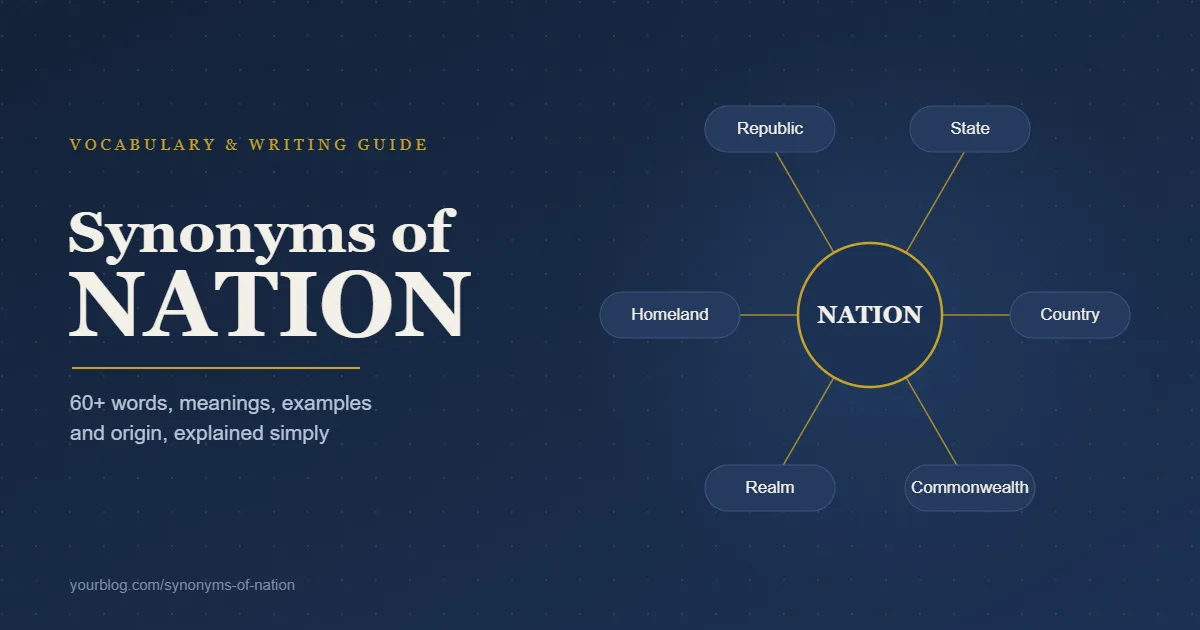
The most common synonyms of “nation” are: country, state, republic, land, commonwealth, homeland, realm, people, and body politic. Each word shifts the meaning slightly “country” focuses on geography, “state” emphasizes political structure, and “homeland” adds an emotional, cultural layer.
That one-line answer covers the basics. But if you actually want to use these words correctly in writing, speeches, or exams you need to understand the differences between them. That’s what the rest of this article does.
Quick Synonyms Table (At a Glance)
If you’re in a hurry, here’s the fastest way to scan every major synonym, what tone it carries, and where it fits best.
| Synonym | Tone / Register | Best Used In |
| Country | Neutral, everyday | General writing, geography |
| State | Formal, political | Law, government, politics |
| Republic | Formal | Political systems with elected leaders |
| Commonwealth | Formal, institutional | Political groupings, formal titles |
| Land | Casual, soft | Everyday writing, storytelling |
| Homeland | Emotional | Personal essays, patriotic content |
| Motherland / Fatherland | Emotional, cultural | Cultural or nationalist writing |
| Realm | Literary, historical | Fiction, poetry, historical writing |
| Domain | Literary | Fiction, formal-historical tone |
| Territory | Neutral | Geopolitical or legal writing |
| Sovereign state | Highly formal | Academic, international relations |
| Nation-state | Academic | Political science, essays |
| Body politic | Formal, older usage | Legal or classical writing |
| Polity | Academic | Political theory |
| People | Neutral to emotional | Human-centered narratives |
This table alone answers most quick searches but the real skill is knowing why one word fits a sentence better than another, which is what we’ll cover next.
What Does “Nation” Actually Mean?
Before swapping the word out, it helps to know what it means in the first place. A nation is a large group of people united by shared factors language, culture, history, ancestry, or territory who often (but not always) live under one government.
This is the detail most articles skip: a nation is fundamentally about people and identity, while a country is about land and borders, and a state is about political authority. That distinction is exactly why the “right” synonym changes depending on what you’re trying to say.
Complete List of Synonyms for “Nation”
Formal & Political Synonyms
These fit government documents, news articles, essays, and formal speeches.
- Country
- State
- Republic
- Commonwealth
- Sovereign state
- Body politic
- Polity
- Dominion
- Confederation
- Federation
Everyday / Common Synonyms
Best for casual writing, blogs, and everyday conversation.
- Land
- Homeland
- Motherland
- Fatherland
- Territory
- Place
- Society
Literary & Poetic Synonyms
Useful in creative writing, speeches, and emotionally charged content.
- Realm
- Empire (historical context)
- Domain
- People
- Race (used historically now largely avoided due to modern connotations)
Geopolitical / Academic Synonyms
Common in political science, history, and international relations writing.
- Nation-state
- Sovereign entity
- Political community
- Ethnic group (related, not identical)
- Civic community
Nation vs. Country vs. State vs. Homeland What’s the Real Difference?
This is the part most people get wrong, and it’s exactly the kind of question Google’s AI Overview tends to pull from articles that explain it clearly.
| Word | Core Focus | Example Sentence |
| Nation | People united by shared identity, culture, or history | “The Kurdish people are often described as a nation without a state.” |
| Country | A defined geographic territory with borders | “France is a country in Western Europe.” |
| State | A political entity with sovereign government and authority | “The state has the power to enforce laws within its territory.” |
| Homeland | Emotional, ancestral connection to a place | “For millions of refugees, returning to their homeland remains a dream.” |
| Republic | A state governed by elected representatives, not a monarch | “The United States is a federal republic.” |
| Commonwealth | A political community formed for shared benefit | “Australia is a member of the Commonwealth of Nations.” |
Simple way to remember it: A country is land. A state is government. A nation is people. A homeland is emotion.
How to Use Each Synonym Correctly (Real Examples)
Picking a synonym isn’t just about variety using the wrong one can quietly change your meaning. Here’s how professional writers actually use them:
1. Country Use when talking about geography or a place on a map.
“Japan is a country known for its blend of tradition and technology.”
2. State Use when discussing government, law, or political power.
“Every sovereign state has the right to defend its borders.”
3. Republic Use specifically when the government is elected, not inherited.
“France transitioned from a monarchy to a republic after the revolution.”
4. Homeland Use when emotion, belonging, or ancestry matters.
“She spoke of her homeland with a mix of pride and longing.”
5. Realm Use in literary, historical, or slightly dramatic contexts.
“The king ruled over a vast and prosperous realm.”
6. Commonwealth Use when referring to a formal political grouping.
“India remains part of the Commonwealth of Nations.”
7. People Use when emphasizing the human collective, not the land or government.
“The Ukrainian people showed remarkable resilience during the war.”
Origin and Etymology of “Nation”
Understanding where a word comes from often explains why it means what it means today and “nation” has a fairly clean, traceable history.
The word traces back to the Latin noun natio, meaning “birth,” “breed,” or “race” itself derived from nasci, “to be born.” In Roman usage, natio originally referred to a group of people born in the same place, sharing common ancestry, almost like a group or breed rather than a political unit.
From Latin, the word passed into Old French as nacion, carrying a similar meaning a group bound together by birth and origin. Middle English borrowed it directly from Old French around the 13th century, and over the next few centuries, “nation” gradually shifted from meaning simply “a people of common descent” to its modern sense: a group of people united by shared culture, language, or history, often (but not always) tied to a specific territory and government.
This is worth knowing because it explains a subtle pattern still visible today words like “nationality” and “native” share the same Latin root (nasci, “to be born”), which is why they all circle around the idea of origin and belonging.
Related Word Forms You Should Know
“Nation” doesn’t exist in isolation it has a whole family of related words, and mixing them up is one of the most common grammar mistakes non-native and native speakers alike make.
- National (adjective) relating to a nation as a whole. “The national anthem played before the match.”
- Nationality (noun) legal membership or citizenship of a nation. “Her nationality is Pakistani, even though she was born in the UK.”
- Nationalism (noun) strong identification with, and support for, one’s own nation, often politically charged. “Rising nationalism reshaped the country’s foreign policy.”
- Nationhood (noun) the state or status of being a nation. “The region has long sought full nationhood and international recognition.”
Nationality vs. Nation What’s the Difference?
This confuses a lot of people, so here’s the clean distinction: a nation is a group of people sharing identity, culture, or history nationality is the legal status that ties an individual to a specific nation or country.
In other words, a nation is the collective; nationality is the individual’s legal membership card to that collective. You can belong to a nation culturally without holding its legal nationality a common reality for diaspora communities and refugees.
Common Collocations With “Nation”
Native speakers rarely use “nation” alone it almost always shows up paired with certain words. Learning these collocations makes your writing sound natural instead of textbook-stiff, and it also helps you rank for related search terms people actually type into Google.
- Nation building the process of constructing or strengthening a nation’s political, economic, and social institutions. “Post-war nation building took decades.”
- Nationwide happening or existing across an entire nation. “The campaign launched nationwide within a week.”
- Nation state a sovereign state where the population largely shares one national identity. “Germany is often cited as a classic nation state.”
- Developing nation a country in the process of industrial and economic growth. “Access to clean water remains a challenge in many developing nations.”
- Industrial nation a nation with a strong manufacturing and industrial economy. “Japan became a leading industrial nation after WWII.”
- Western nation a nation typically associated with Western Europe, North America, or culturally aligned regions. “Several Western nations imposed new trade restrictions.”
Using these naturally throughout your writing instead of forcing “nation” into every sentence is one of the simplest ways to sound fluent and, as a bonus, it mirrors how real search queries are phrased.
Common Mistakes Writers Make
- Using “state” and “nation” interchangeably. A state is a political-legal entity; a nation is a cultural-social one. The Palestinian nation, for instance, exists as a widely recognized people even where statehood is disputed this is exactly the kind of nuance that trips up both students and journalists.
- Overusing “country” in academic writing. In political science essays, “country” sounds too casual. “Sovereign state” or “nation-state” reads more precise.
- Treating “homeland” as neutral. It carries emotional weight. Using it in a purely factual or statistical sentence can feel out of place.
- Confusing “empire” with “nation.” An empire typically rules over multiple nations or peoples it isn’t a direct synonym, just a related concept.
- Mixing up “nationality” and “nation.” As explained above, one is a collective identity, the other a legal status they aren’t interchangeable in formal writing.
- Repeating the same synonym throughout an entire article. Ironically, this is the exact problem people are trying to fix when they search “synonyms of nation” yet many end up overcorrecting and using an obscure word repeatedly instead, which reads just as awkwardly as repetition.
Pro Tips for Choosing the Right Word
- Match the register. Formal writing (legal, academic, journalistic) calls for “state,” “republic,” or “sovereign entity.” Casual or narrative writing allows “land,” “homeland,” or “country.”
- Think about what you’re emphasizing. People? Use “nation” or “people.” Government? Use “state.” Land? Use “country” or “territory.” Emotion? Use “homeland” or “motherland.”
- Avoid mechanical thesaurus-swapping. Don’t just replace “nation” with a random synonym for the sake of variation check that the sentence still means what you intended.
- Read historical vs. modern usage carefully. Words like “race” or “union ” as synonyms for nation are largely outdated and can sound insensitive in modern writing stick to current academic terms like “ethnic group” or “political community” instead.
- In SEO or content writing, rotate 3–4 core synonyms, not all sixty. Overloading an article with obscure alternatives (like “polity” or “dominion”) can confuse general readers, even if it looks impressive.
- Use collocations, not just single-word swaps. Phrases like “nation building” or “developing nation” sound more natural and search-friendly than forcing a lone synonym into every sentence.
AI Overview Summary (Quick Facts)
- Most common synonym: country
- Most formal synonym: sovereign state
- Most emotional synonym: homeland
- Most literary synonym: realm
- Key difference: nation = people/identity, country = land, state = government
- Word origin: Latin natio → Old French nacion → Middle English “nation”
- Related forms: national, nationality, nationalism, nationhood
- Outdated synonyms to avoid in modern writing: race (when referring to nation-states)
Frequently Asked Questions
Synonyms of Nation in English
A nation is a large group of people who share a common identity, history, culture, or language. Depending on the context, you can also use words like country, state, homeland, republic, kingdom, or people.
Real-life example:
Canada is a nation known for its multicultural population and beautiful landscapes.
Nation Synonym and Antonym
The most common synonyms of nation include country, state, republic, kingdom, homeland, and land. Common antonyms depend on context and may include individual, outsider, foreign territory, or statelessness when discussing political identity.
Real-life example:
Japan is a peaceful nation, while a person without citizenship may be described as stateless.
Synonyms of Nation Slang
In casual conversations, people sometimes use informal words like the homeland, the motherland, the old country, or our side to refer to a nation. These expressions are more common in speech than in formal writing.
Real-life example:
After living abroad for years, Maria said she couldn’t wait to visit the old country again.
Synonyms of Country
Although country and nation are often used interchangeably, alternatives include state, homeland, republic, kingdom, territory, and land. The best choice depends on whether you’re talking about geography, government, or culture.
Real-life example:
Australia is both a country and a sovereign state with its own government.
Nation Antonyms
The opposite of nation varies by context. Possible antonyms include statelessness, foreign land, colony, or individual, especially when contrasting a single person with an entire nation.
Real-life example:
After losing his citizenship, he experienced a period of statelessness before gaining a new nationalit.
What Is a Nation?
A nation is a community of people connected by shared culture, language, history, or identity. In many cases, a nation also has its own government and recognized borders, though not every nation is an independent country.
Real-life example:
The Kurdish people are often described as a nation because they share a common culture and history.
Nation Sentence
Seeing a word in context makes it easier to understand. Here are a few simple sentences using nation correctly in everyday English.
Real-life example:
The entire nation celebrated the team’s victory after they won the international championship.
Nation-State Synonym
A nation-state is a country where the people largely share the same national identity and are governed by one sovereign state. Similar terms include sovereign state, independent state, and self-governing country.
Real-life example:
Iceland is often used as an example of a nation-state because it has a distinct national identity and an independent government.
Final Thoughts
“Nation” is a simple word carrying a surprisingly complex idea people, land, government, and identity, all wrapped into five letters, and traced all the way back to a Latin word for “birth.”
The trick isn’t memorizing every synonym on this list; it’s understanding why each one exists and when it fits. Once you see the difference between a country (land), a state (government), a nation (people), and a nationality (legal status), choosing the right word stops being guesswork and starts being precise which is exactly what good writing, and good SEO, both reward.

I’m William Parker, an English language enthusiast and content writer with a passion for words and clear communication. I specialize in writing well-researched content about synonyms, vocabulary, grammar, and word meanings. My goal is to help students, writers, and English learners expand their vocabulary and choose the right words with confidence. I believe learning English should be simple, practical, and enjoyable for everyone.